
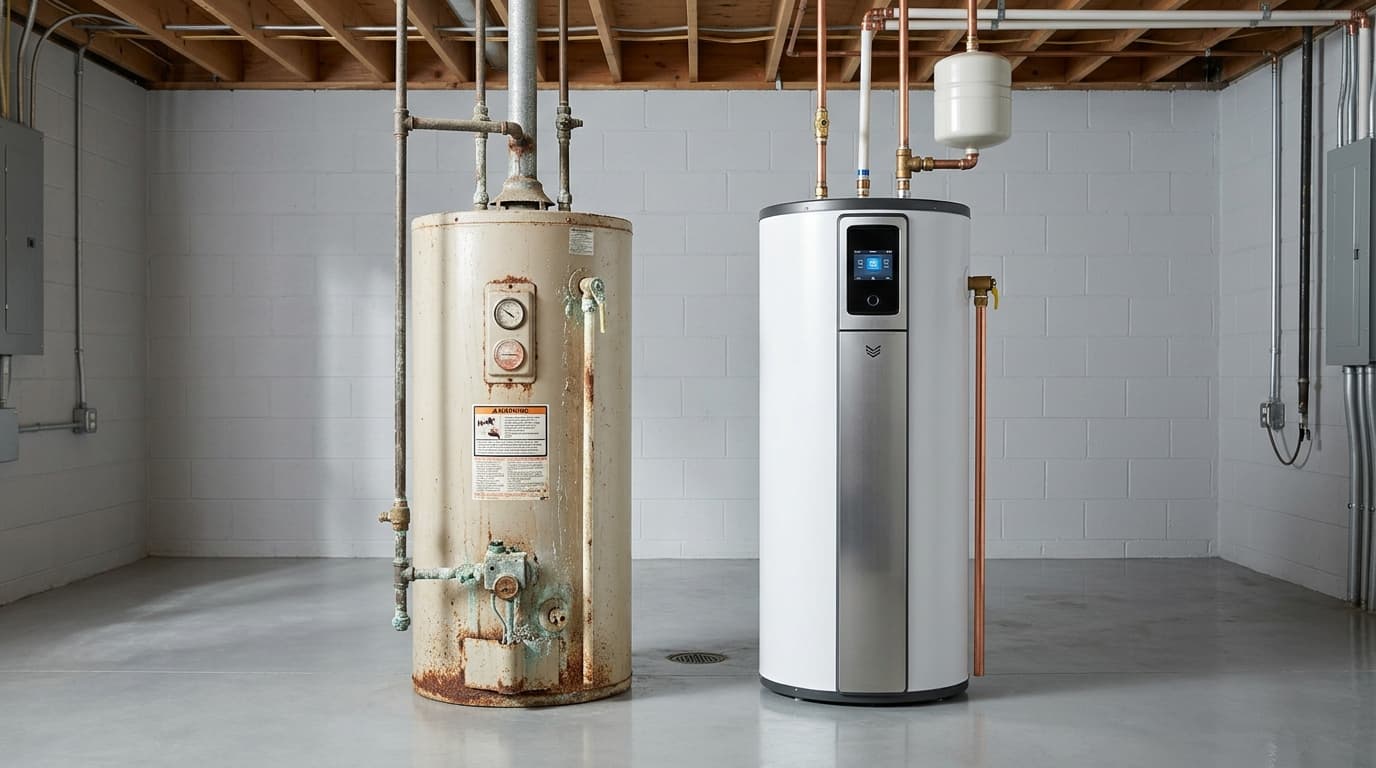
Repair or Replace a Water Heater? How to Decide
By Renovation Cost Lab Editorial · Last reviewed 2025-01-01
There is no universal rule. Whether to repair or replace a water heater depends on the unit's age and condition, how the repair cost compares to a new unit, the efficiency you would gain, and any safety issues — not a single threshold. A minor part on a young, healthy unit usually favors repair; a leaking tank, repeated failures, or a very old unit usually favors replacement. Enter your own repair quote, replacement quote, and realistic remaining years into the annualized cost calculator to compare the two paths on equal footing.
Key cost factors
- Age and overall condition of the unit
- Repair cost vs. the price of a new water heater
- Whether the tank itself is leaking (vs. a replaceable part)
- Energy efficiency you would gain from a newer model
- Remaining useful years you can realistically expect
- Safety and code issues (gas, electrical, venting, T&P valve)
Quick Answer
There is no one rule that answers this for every water heater. The decision comes down to a handful of factors working together: the unit's age and condition, how the repair cost compares to a new unit, the efficiency you would gain, and any safety or code concerns.
Be skeptical of fixed "useful life" numbers and blanket thresholds. Instead, put your own figures into the annualized cost calculator: your repair quote, your replacement quote, and an honest estimate of how many more years each path buys you. Comparing the two costs per year of service is a far more reliable guide than any rule of thumb.
When Repair Usually Makes Sense
Repair tends to be the stronger choice when the problem is contained and the unit is otherwise in good shape:
- A minor, replaceable part has failed — for example a thermocouple, heating element, thermostat, igniter, or anode rod — rather than the tank itself.
- The unit is relatively young and has a clean service history with no prior major failures.
- The repair is modest relative to a new unit and you expect several more years of service afterward.
- There are no active safety or venting problems and the tank is not leaking.
In these cases the repair often costs far less per year of remaining service than buying new. Confirm that by running your numbers rather than assuming it.
When Replacement Usually Makes Sense
Replacement tends to be the stronger choice when the issues point to the end of the unit's practical life:
- The tank itself is leaking. A leaking storage tank generally cannot be repaired — once the steel tank corrodes through, the unit needs to be replaced.
- You are facing repeated or escalating failures, where you keep paying for fix after fix.
- The unit is very old and any repair only postpones a near-term replacement.
- A newer model would deliver meaningful efficiency gains, or you want to change fuel type or move to a tankless/heat-pump design.
- Bringing the existing installation up to current code would be costly on its own.
Here the replacement often wins on annualized cost because it buys many more years of service, even at a higher upfront price.
How to Compare Costs Fairly
The fairest way to compare the two paths is annualized cost: the total cost of a path divided by the number of usable years it buys.
Annualized cost = total path cost / usable years.
- Repair path: the repair quote (plus any repairs you realistically expect soon) divided by the remaining years you expect from the existing unit.
- Replacement path: the installed price of the new unit divided by the years you expect from it.
Whichever path has the lower cost per year is generally the better value. Conceptually, there is a break-even point — if the repair buys you enough added years that its cost-per-year drops below the new unit's cost-per-year, repair wins; if not, replacement wins. The honesty of the "usable years" estimate matters more than any single price.
You will sometimes hear a rough heuristic such as "replace if the repair costs more than about half the price of a new unit." Treat that only as a rough starting point, not a rule — it ignores efficiency, safety, and how many years each path actually buys. The annualized comparison is the honest version of the same idea. Use the calculator to run it with your numbers.
Safety & Code Notes
Water heaters combine pressurized hot water with either a gas burner and combustion venting or high-voltage electrical connections, so safety is not optional:
- Gas connections, combustion venting, and electrical work should be handled by a licensed professional. Improper venting can allow carbon monoxide into the home.
- Never cap, plug, or disable the temperature-and-pressure (T&P) relief valve. It is a critical safety device; if it leaks or weeps, have the cause diagnosed rather than defeating the valve.
- Permits and code requirements vary by jurisdiction. Many areas require a permit and inspection for a water heater replacement, and current code may mandate seismic strapping, expansion tanks, drain pans, or updated venting.
If a failure involves gas odor, scorching, backdrafting, or active leaking, shut the unit down and bring in a qualified pro before deciding anything.
Factors Beyond Cost
Money is only part of the decision. Weigh these alongside the annualized comparison:
- Safety: any unresolved combustion, venting, or electrical hazard pushes strongly toward replacement.
- Efficiency: a newer unit may lower operating cost and improve recovery/hot-water availability, though real savings depend on usage and local energy prices.
- Warranty: a new unit typically carries a fresh warranty, while an aging repaired unit usually does not.
- Code: replacement is a natural moment to bring the installation up to current requirements.
Estimate your project
Adjust the inputs to match your project and local prices.
How many more years of use the repair realistically buys. Your estimate.
Expected usable years of the new unit. Your estimate.
e.g. extra energy cost of keeping an inefficient old unit.
The period you want to think over. If it exceeds the added repair years, you will be warned.
Frequently asked questions
- How do I decide whether to repair or replace my water heater?
- There is no single rule. Weigh the unit's age and condition, the repair cost against a new unit, the efficiency you would gain, and any safety or code issues. The most reliable approach is to compare the annualized cost of each path — total cost divided by the usable years it buys — using your own quotes in the calculator.
- Is a leaking water heater tank repairable?
- Usually not. If the steel storage tank itself is leaking, it has typically corroded through and cannot be reliably repaired, so the unit generally needs to be replaced. Leaks at fittings, valves, or connections are a different matter and can sometimes be fixed — have a professional confirm where the leak is actually coming from.
- Can I replace a water heater myself?
- For most people this is a job for a licensed professional. Replacement commonly involves gas lines and combustion venting or high-voltage electrical connections, and many jurisdictions require a permit and inspection. Mistakes can cause carbon monoxide exposure, fire, water damage, or a failed inspection, so treat DIY replacement with caution.
Sources & pricing methodology
- Renovation Cost Lab user-input cost modelThis topic does not bundle fixed prices. The decision tool uses the repair quote, replacement quote, and expected usable years that YOU enter to compute and compare annualized cost. There are no national averages implied.
- General water heater safety referenceGeneral educational reference only. Gas, electrical, venting, T&P valve, and permit requirements vary by model and jurisdiction — follow the manufacturer's instructions and your local code, and use a licensed professional.
See our full pricing methodology and editorial policy.