
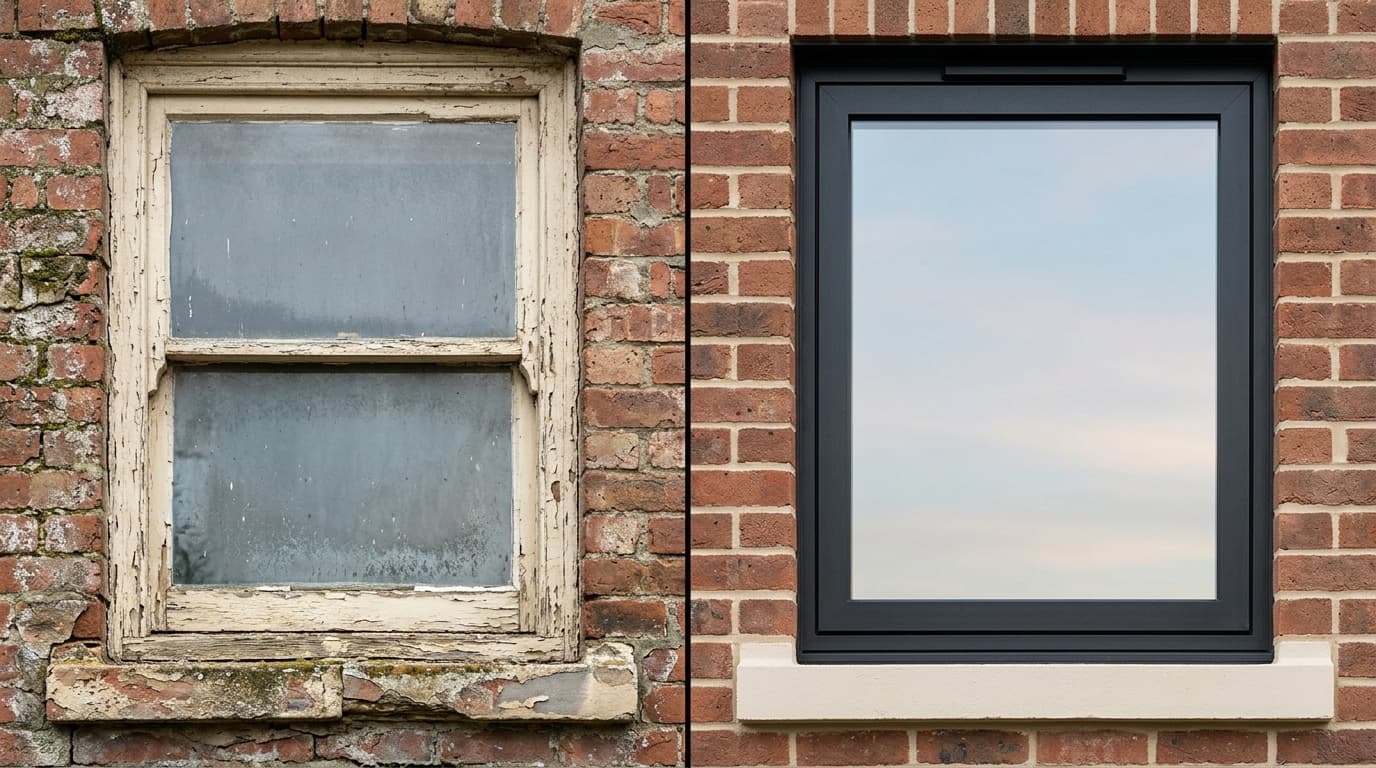
Repair or Replace Windows? How to Decide
By Renovation Cost Lab Editorial · Last reviewed 2025-01-01
There is no universal rule. Whether to repair or replace a window depends on what has actually failed, the window's overall condition, the energy and comfort you would gain, and how the repair cost compares to a new window — not a single threshold. A fogged insulated glass unit (IGU), a sticking sash, or worn hardware on an otherwise sound frame often favors repair; rot, structural damage, failed frames throughout the house, or a desire for much better efficiency often favors replacement. Enter your own repair quote, replacement quote, and realistic remaining years into the annualized cost calculator to compare the two paths on equal footing.
Key cost factors
- What actually failed (fogged IGU, sash, hardware, or the frame itself)
- Overall condition of the frame and surrounding wall (rot, water damage)
- Repair cost vs. the price of a replacement window
- Energy performance and comfort you would gain from a new unit
- How many windows are affected (one vs. a whole-house pattern)
- Remaining useful years you can realistically expect from each path
Quick Answer
There is no one rule that answers this for every window. The decision comes down to a few factors working together: what actually failed, the condition of the frame and surrounding wall, the energy and comfort you would gain, and how the repair cost compares to a new window.
Be skeptical of fixed "useful life" numbers and blanket thresholds. Instead, put your own figures into the annualized cost calculator: your repair quote, your replacement quote, and an honest estimate of how many more years each path buys you. Comparing cost per year of service is far more reliable than any rule of thumb.
When Repair Usually Makes Sense
Repair tends to be the stronger choice when the problem is contained and the window is otherwise sound:
- A fogged or failed insulated glass unit (IGU) — the seal between the panes has failed, but the frame and sash are in good shape. In many cases the glass unit can be replaced without replacing the whole window.
- A sticking or damaged sash, a broken balance, worn weatherstripping, or failed hardware (locks, cranks) on a frame that is still solid.
- The frame shows no rot or water damage and the surrounding wall is dry.
- Only one or a few windows are affected, rather than a whole-house pattern.
- The repair is modest relative to a new unit and buys you several more years of service.
In these cases the repair often costs far less per year of remaining service than buying new. Confirm that by running your own numbers rather than assuming it.
When Replacement Usually Makes Sense
Replacement tends to be the stronger choice when the window has reached the end of its practical life or no longer performs:
- The frame is rotted, warped, or water-damaged, or the window no longer closes, seals, or locks reliably.
- You are facing repeated failures or a whole-house pattern where many windows are at the same stage — replacing in one project is often more efficient than repeated spot repairs.
- You want a meaningful efficiency or comfort gain — reduced drafts, less condensation, better noise control — that a repair cannot deliver.
- Replacement parts are no longer available for an older or discontinued window.
- There is moisture intrusion or hidden damage in the wall around the opening that needs to be addressed anyway.
Here replacement often wins on annualized cost because it buys many more years of service and may improve efficiency, even at a higher upfront price. Note that any projected energy savings depend on your climate, local energy prices, and the rest of the home — treat them as a factor, not a guarantee.
How to Compare Costs Fairly
The fairest way to compare the two paths is annualized cost: the total cost of a path divided by the number of usable years it buys.
Annualized cost = total path cost / usable years.
- Repair path: the repair quote (plus any repairs you realistically expect soon) divided by the remaining years you expect from the existing window.
- Replacement path: the installed price of the new window divided by the years you expect from it.
Whichever path has the lower cost per year is generally the better value. Conceptually, there is a break-even point — if the repair buys enough added years that its cost-per-year drops below the new window's cost-per-year, repair wins; if not, replacement wins. The honesty of the "usable years" estimate matters more than any single price.
You will sometimes hear a rough heuristic such as "replace if the repair costs more than about half the price of a new window." Treat that only as a rough starting point, not a rule — it ignores efficiency, comfort, and how many years each path actually buys. The annualized comparison is the honest version of the same idea. Use the calculator to run it with your numbers.
| Leans toward repair | Leans toward replace |
|---|---|
| Fogged IGU, sash, or hardware on a sound frame | Rotted, warped, or water-damaged frame |
| One or a few windows affected | Whole-house pattern of failures |
| Repair is modest vs. a new unit | Repair approaches or exceeds replacement cost |
| Current performance is acceptable | You want a real efficiency/comfort gain |
| Parts still available | Parts discontinued or unavailable |
Factors Beyond Cost
Money is only part of the decision. Weigh these alongside the annualized comparison:
- Energy and comfort: a newer unit may reduce drafts, condensation, and noise, though real energy savings depend on climate, energy prices, and the rest of the home.
- Condition of the opening: hidden rot or moisture in the surrounding wall can turn a "simple" repair into a larger project — and is a reason to open things up and address it properly.
- Consistency: matching a repaired window to others in the house, or the appearance of mismatched units, may matter to you.
- Code and warranty: replacement may bring the unit up to current egress or energy requirements and typically carries a fresh warranty; a repaired window usually does not.
Safety & Code Notes
Most window work is lower-risk than, say, gas or structural work, but a few things still warrant care:
- Older paint and glazing in homes built before the late 1970s may contain lead; disturbing it has health implications and may require a certified contractor. Do not sand or scrape old window paint casually.
- Egress requirements: bedroom and basement windows often must meet minimum opening sizes for emergency escape. Replacement is a moment to confirm the opening still complies with current code.
- Working at height or over stairs and handling large glass units carry injury and breakage risk — use appropriate help and equipment, or a professional.
- Permits vary by jurisdiction. Like-for-like repairs often need none, but changing the opening size or structure usually does. Check your local building department.
If you find rot, mold, or water damage in the wall around a window, or suspect lead paint, bring in a qualified professional before deciding anything.
Estimate your project
Adjust the inputs to match your project and local prices.
How many more years of use the repair realistically buys. Your estimate.
Expected usable years of the new unit. Your estimate.
e.g. extra energy cost of keeping an inefficient old unit.
The period you want to think over. If it exceeds the added repair years, you will be warned.
Frequently asked questions
- How do I decide whether to repair or replace a window?
- There is no single rule. Weigh what actually failed, the condition of the frame and surrounding wall, the energy and comfort you would gain, and how the repair cost compares to a new window. The most reliable approach is to compare the annualized cost of each path — total cost divided by the usable years it buys — using your own quotes in the calculator.
- Can a fogged window be fixed without replacing the whole window?
- Often, yes. Fogging usually means the seal in the insulated glass unit (IGU) has failed. If the frame and sash are sound, many windows allow the glass unit alone to be replaced rather than the entire window. Have a professional confirm whether your window supports a glass-only replacement.
- Will new windows pay for themselves in energy savings?
- Not necessarily. New windows can reduce drafts and improve comfort, but actual energy savings depend on your climate, local energy prices, and the rest of your home's condition. We do not present energy savings as guaranteed — treat them as one factor in the decision, not a payback promise.
Sources & pricing methodology
- Renovation Cost Lab user-input cost modelThis topic does not bundle fixed prices. The decision tool uses the repair quote, replacement quote, and expected usable years that YOU enter to compute and compare annualized cost. There are no national averages implied.
- General window performance and safety referenceGeneral educational reference only. Energy performance, egress requirements, lead-paint handling, and permit rules vary by product and jurisdiction — follow the manufacturer's instructions and your local code, and use a qualified professional where appropriate.
See our full pricing methodology and editorial policy.