
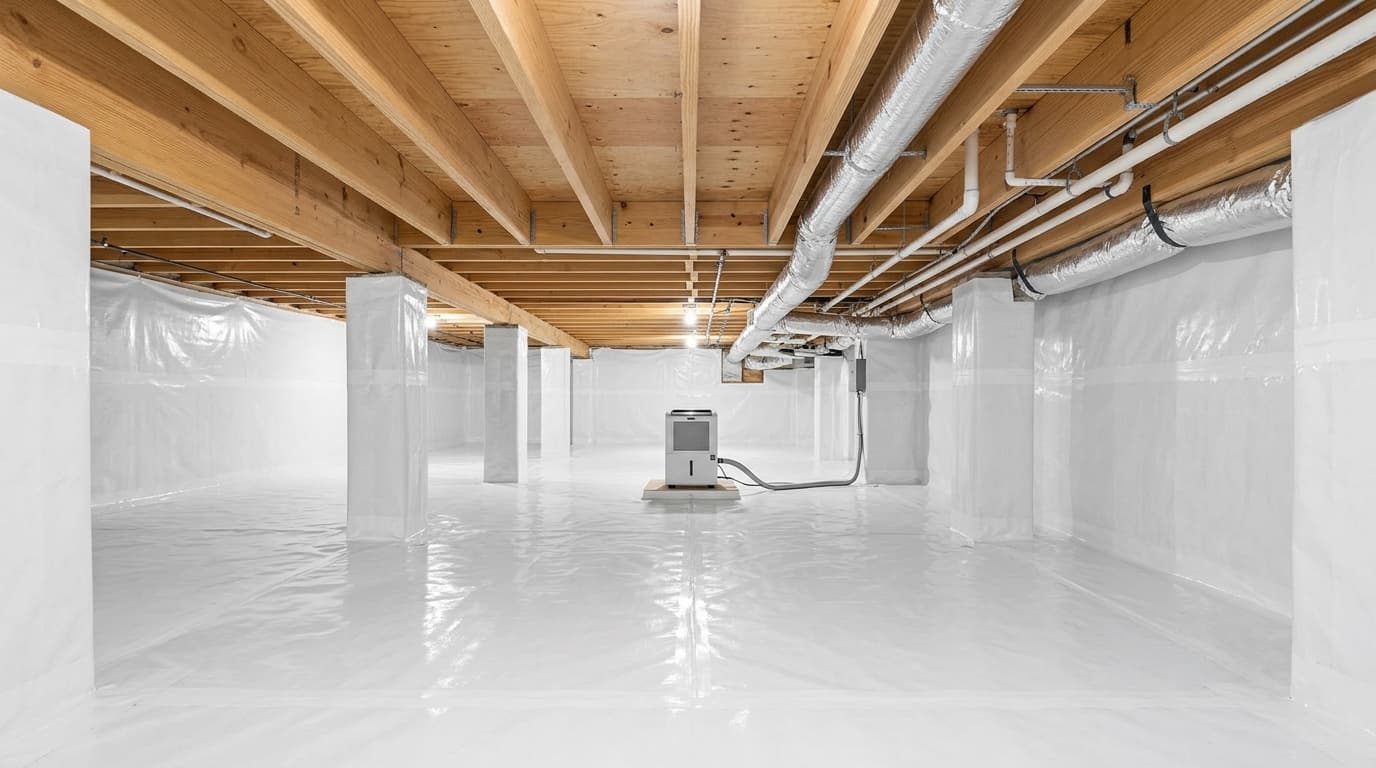
Crawl Space Encapsulation Cost: Vapor Barrier, Drainage & Dehumidifier
By Renovation Cost Lab Editorial · Last reviewed 2025-01-01
Crawl space encapsulation is usually budgeted per square foot of floor area, plus line items for sealing vents, adding a sump or drainage, and installing a dehumidifier. As an editable planning range, a thicker, reinforced vapor barrier and a full encapsulation (walls plus floor, sealed vents, conditioned air) cost more per square foot than a partial floor-only liner. Treat every figure here as a planning assumption and adjust it to local quotes — these are not national averages.
Key cost factors
- Crawl space floor and wall square footage
- Vapor barrier thickness (mil) and whether it is reinforced
- Scope: partial (floor-only) vs. full (walls, floor, sealed vents)
- Drainage needs (interior drain and sump pump) if water intrudes
- Dehumidifier size and whether the space is conditioned
- Insulation of walls or rim joists, plus access and clearance
Quick Cost Overview
Crawl space encapsulation pricing is driven mostly by floor and wall square footage and by how complete the job is. A basic floor-only vapor barrier is the cheapest version; a full encapsulation that lines the walls, seals the vents, adds drainage, and runs a dedicated dehumidifier costs considerably more.
Barrier thickness matters too. A thin liner (around 6 mil) is inexpensive but tears easily; a reinforced 10–20 mil barrier costs more per square foot but holds up to foot traffic and service work. Every unit price below is an editable planning assumption — replace it with a local quote before you commit.
Cost Drivers and Component Breakdown
Encapsulation is really a bundle of components. Pricing them separately helps you see where the money goes and what you can stage over time:
| Component | What it covers | Relative cost driver |
|---|---|---|
| Vapor barrier | Sealed liner over floor (and often walls) | Square footage × mil thickness; reinforced costs more |
| Vent sealing | Closing foundation vents to the outside | Number of vents; sealed covers and foam |
| Drainage / sump | Interior perimeter drain feeding a sump pump | Only needed where water enters; adds excavation and a pump |
| Dehumidifier | Controls humidity in the sealed space | Unit size and whether ducting/condensate drainage is added |
| Insulation | Wall board or rim-joist air sealing | Linear/square footage; material choice |
Because a dry, sealed crawl space can still develop problems if the underlying water source is not addressed, drainage is sometimes the first dollar you should spend — not the barrier.
Partial vs. Full Encapsulation
Partial encapsulation typically means a floor liner and maybe rim-joist sealing, leaving vents open. It is cheaper and can reduce ground moisture, but it does not fully control humidity.
Full encapsulation lines the walls and floor with a reinforced barrier, seals the vents, and conditions the air with a dehumidifier. It costs more but is the version most often recommended where humidity, odors, or moisture are ongoing concerns. Match the scope to the actual problem rather than defaulting to the most expensive package.
DIY vs. Professional Installation
Laying a floor-only vapor barrier in a clean, dry, accessible crawl space can be a DIY project if you are comfortable working in a tight space. Full encapsulation — sealing walls, taping seams to be airtight, installing drainage and a sump, and sizing a dehumidifier — is usually a professional job because small sealing errors undercut the whole system.
If you DIY, budget for knee pads, a respirator, and extra barrier material; crawl spaces are dusty, awkward, and sometimes contain hazards you cannot see from the hatch.
When a Professional Should Assess the Space
Stop and bring in a qualified professional before encapsulating if you see any of the following: standing water, persistent dampness, a musty smell, visible mold, wood rot, or sagging/cracked structural members. Sealing moisture or mold inside an encapsulated space can make the problem worse, not better.
Water intrusion and structural issues should be diagnosed and corrected by a qualified pro first. Encapsulation controls ground moisture and humidity — it is not a guaranteed cure for an active leak, and no one can promise a permanently dry space without first finding and fixing the source.
Common Budget Mistakes
- Choosing the thinnest barrier to save money, then replacing it after it tears.
- Encapsulating over an unaddressed water source and expecting it to stay dry.
- Skipping the dehumidifier on a full encapsulation, so humidity still climbs.
- Forgetting to account for a sump pump, drainage, or electrical work when water is present.
- Treating a national "average" as your quote. Always confirm locally.
Frequently asked questions
- How is crawl space encapsulation priced?
- Most commonly per square foot of floor (and wall) area, plus separate line items for vent sealing, drainage/sump, a dehumidifier, and any insulation. Barrier thickness in mils and whether it is reinforced also move the per-square-foot figure.
- What vapor barrier thickness should I use?
- Thin 6 mil liners are the cheapest but tear easily. Reinforced barriers in the roughly 10–20 mil range cost more but withstand foot traffic and service work. The right choice depends on how the space will be used and what your contractor recommends.
- Will encapsulation guarantee a dry crawl space?
- No. Encapsulation controls ground moisture and humidity, but if there is an active leak or drainage problem it must be found and fixed first by a qualified professional. We do not present a dry crawl space as guaranteed.
Sources & pricing methodology
- Renovation Cost Lab editable demonstration datasetDefault unit prices are reasonable planning assumptions, not verified national averages. See our pricing methodology.
- U.S. Department of Energy — crawl space moisture and sealing guidance (general reference)General educational reference for crawl space moisture and insulation concepts; verify current recommendations for your region.https://www.energy.gov/energysaver/types-insulation
See our full pricing methodology and editorial policy.