
Laminate vs. Vinyl (LVP) Flooring Cost: Head-to-Head Comparison & Budget Calculator
By Renovation Cost Lab Editorial · Last reviewed 2025-01-01
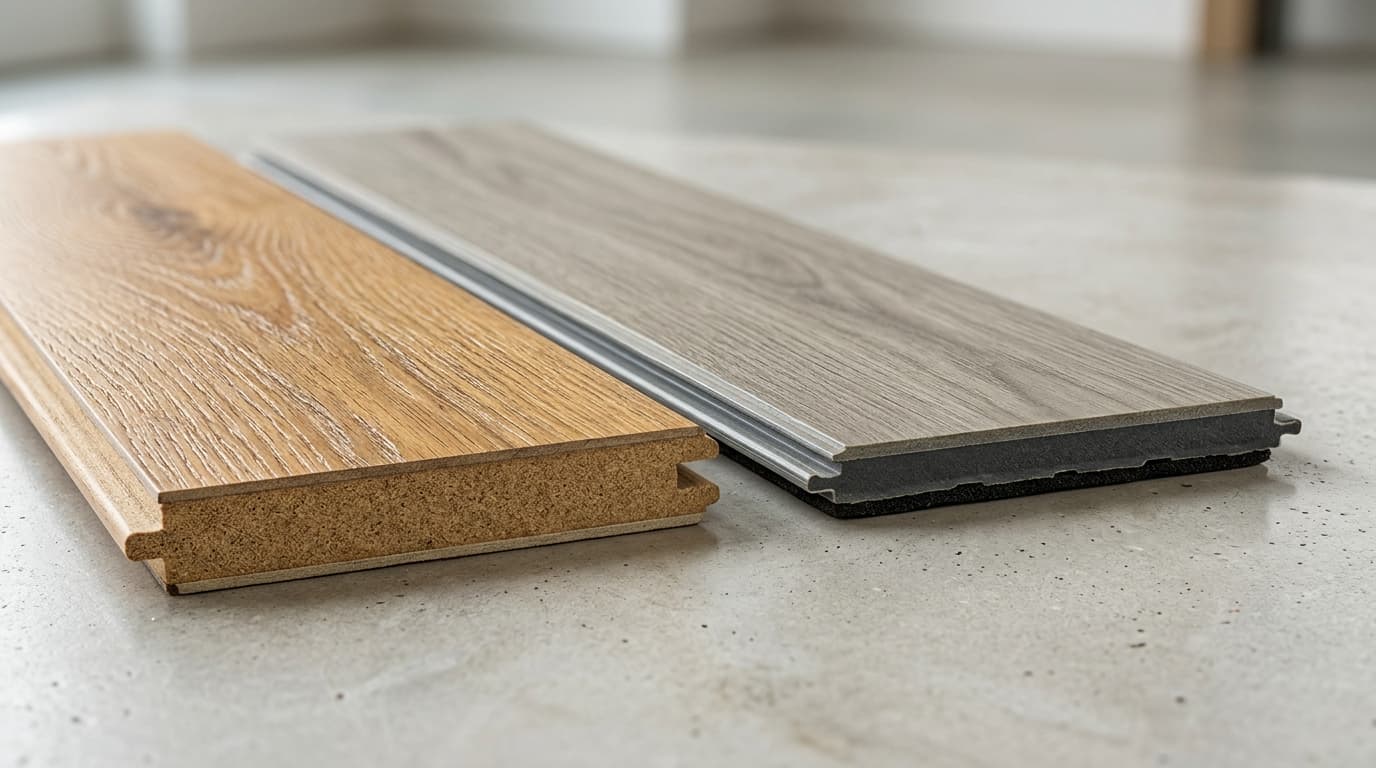
Both laminate and luxury vinyl plank (LVP) are budgeted per square foot (material plus labor), adjusted for a waste factor and any subfloor prep, removal, and underlayment. The main practical difference is water: most LVP is highly water-resistant and suits bathrooms, kitchens, and basements, while traditional laminate has a wood-fiber core that is vulnerable to standing water, though water-resistant laminate lines exist. Laminate often feels firmer and can mimic wood convincingly; LVP is usually softer underfoot and quieter. On cost the two overlap heavily and depend more on grade than on category. Choose by room and moisture exposure first, then compare like-for-like quotes. These are planning assumptions, not national averages.
Key cost factors
- Room and moisture exposure (bathroom, kitchen, basement vs. bedroom)
- Water resistance of the specific product line
- Material grade, thickness, and wear layer
- Labor rate and install method (both are usually floating click-lock)
- Waste factor (pattern and plank size driven)
- Subfloor condition, prep, underlayment, and old-floor removal
Quick Cost Overview
Laminate and luxury vinyl plank (LVP) are often cross-shopped because they install similarly — both are commonly floating click-lock floors — and their price ranges overlap heavily. For budgeting, both follow the same structure: a combined material-plus-labor rate per square foot, a waste factor on the material, and line items for underlayment, subfloor prep, and removal.
Because the categories overlap so much on price, the decision is usually driven less by cost and more by water exposure, feel, and the room. Our calculator models both the same way, so you can price each option with your own editable assumptions. Every unit price is an editable planning assumption — replace it with a local quote for accuracy.
Head-to-Head Comparison
Here is how the two compare on the factors that usually decide the choice. These are general category tendencies — specific products vary, so always check the data sheet for the exact line you are considering.
| Factor | Laminate | Luxury vinyl plank (LVP) |
|---|---|---|
| Core / make-up | Wood-fiber (HDF) core with a printed image layer and wear coat | All-synthetic (PVC) plank, rigid (SPC/WPC) or flexible |
| Water resistance | Traditional laminate is vulnerable to standing water; water-resistant lines exist | Most LVP is highly water-resistant; many are suitable for wet areas |
| Cost (per sq ft) | Overlaps with LVP; grade matters more than category | Overlaps with laminate; grade matters more than category |
| Durability / wear | Hard surface, scratch-resistant; damaged planks are swapped, not refinished | Tough wear layer resists scratches and dents; damaged planks are swapped |
| Feel & sound | Firmer underfoot; can sound hollow without good underlayment | Softer and warmer underfoot; often quieter |
| Installation | Usually floating click-lock; DIY-friendly | Floating click-lock or glue-down; floating is DIY-friendly |
| Best for | Bedrooms, living rooms, and dry areas where a firm, wood-like feel is wanted | Kitchens, bathrooms, basements, and high-moisture or high-traffic areas |
We do not publish lab performance numbers for either category here, because they vary by product and manufacturer. Use this table to narrow your choice, then confirm the specifics — water rating, wear-layer thickness, warranty — on the exact product's data sheet.
Cost Components
Both floors are budgeted the same way — a sum of parts, not a single number. These are editable planning ranges that apply to either category; adjust each to match your own quote:
| Component | How it is measured | Editable planning range | Notes |
|---|---|---|---|
| Material (plank) | Per square foot | ~$1.50-$5.00 / sq ft | Grade, thickness, and wear layer drive the spread for both |
| Labor | Per square foot | ~$1.50-$4.00 / sq ft | Floating click-lock is cheaper than glue-down |
| Underlayment | Per square foot | ~$0.30-$0.80 / sq ft | Skip if planks have attached pad; needed otherwise |
| Subfloor prep | Per square foot or flat fee | ~$0.50-$2.00 / sq ft | Leveling, patching, or moisture barrier as needed |
| Removal & disposal | Per square foot or flat fee | ~$0.50-$2.00 / sq ft | Varies with existing floor type and glue |
Because the ranges overlap so much, the cheaper category is rarely the right framing — a premium laminate can cost more than a basic LVP and vice versa. Compare like-for-like grades, and let the room decide.
Which to Choose by Room
Start with moisture, since it is the clearest dividing line:
- Bathrooms, kitchens, laundry, and basements: favor LVP for its water resistance. If you prefer laminate here, use a product explicitly rated as water-resistant and follow its guidance — standard laminate and standing water do not mix.
- Bedrooms, living rooms, and other dry areas: either works. Choose laminate if you want a firmer, convincingly wood-like surface, or LVP if you want something softer, warmer, and quieter underfoot.
- High-traffic entries and hallways: both wear well; LVP's water resistance is a bonus near exterior doors.
- Over concrete slabs or in-floor radiant heat: confirm the specific product's suitability and moisture requirements on its data sheet before buying.
When a home mixes wet and dry rooms, many people run LVP in the wet areas and either continue it or switch to laminate in the bedrooms to balance feel and budget.
Waste Factor Explained
For both floors you buy more material than the measured area, because planks get cut to fit walls, doorways, and obstacles, and some cuts cannot be reused. A common starting point is 8-10% extra for a straightforward layout in rectangular rooms.
Waste varies by pattern and material for both categories. Diagonal installations typically push waste toward 15%, and herringbone or chevron patterns can need more because of the angled cuts. Longer planks, busy visuals that need matching, and rooms with many jogs or closets also raise waste. Order an extra box so your dye lot matches — a mid-project resupply can differ.
DIY vs. Professional
Both floors are among the more DIY-friendly options when installed as floating click-lock: with basic tools, careful measuring, and patience, many homeowners install either one and save on labor. The trade-offs are the same for both — time, the learning curve on cuts and transitions, and the fact that layout or subfloor-prep mistakes show up later.
Glue-down LVP, large open areas, complex patterns, and floors needing significant subfloor correction are better suited to a professional, who also typically handles removal, disposal, and warranty-compliant prep. The install decision is similar between the two categories — it is driven more by method and room than by laminate-versus-vinyl.
Limitations & Honest Caveats
A few honest points to keep the comparison realistic:
- Neither can be refinished. Unlike hardwood, both are wear-layer surfaces — damaged planks are replaced, not sanded.
- "Water-resistant" is not "waterproof." Even highly water-resistant LVP relies on seams and edges; standing water, flooding, and poor subfloor moisture control can still cause problems. Follow the product's guidance.
- Category labels blur. Water-resistant laminate and premium rigid-core vinyl have narrowed the old gaps, so judge the specific product, not the category stereotype.
- We do not publish fabricated spec numbers. Wear-layer thickness, water ratings, and warranty terms vary by product — confirm them on the manufacturer's data sheet rather than relying on a category generalization.
Common Budget Mistakes
- Choosing by category price alone instead of comparing like-for-like grades of each.
- Putting standard laminate in a bathroom, kitchen, or basement where moisture is a real risk.
- Budgeting only material-plus-labor and forgetting waste, underlayment, prep, and removal.
- Using a standard 8-10% waste factor for a diagonal or herringbone layout that needs more.
- Assuming "water-resistant" means the floor can sit in standing water indefinitely.
- Treating a national "average" as your quote. Always confirm locally.
Estimate your project
Adjust the inputs to match your project and local prices.
Add a row per room. For irregular rooms, enter an equivalent length × width that matches the measured area.
Leave 0 to use the material default.
Extra material for cuts. Diagonal / herringbone patterns need more; tile typically higher than carpet.
Adds $1.50/sq ft for tear-out and disposal.
Adds $0.55/sq ft of underlayment / padding.
Leave 0 to use the material default.
Frequently asked questions
- Is laminate or vinyl (LVP) cheaper?
- Their per-square-foot ranges overlap heavily, so neither category is reliably cheaper — the grade, thickness, and wear layer you choose matter more than whether it is labeled laminate or vinyl. Price the specific products you are considering with the same waste, underlayment, prep, and removal assumptions, and compare the installed totals rather than the category.
- Which is better for a bathroom or basement?
- Generally LVP, because most vinyl is highly water-resistant and many lines are suitable for wet and below-grade areas. Traditional laminate has a wood-fiber core that can swell with standing water. If you prefer laminate in these rooms, use a product explicitly rated as water-resistant and follow its installation guidance.
- Can I refinish laminate or vinyl like hardwood?
- No. Both are wear-layer surfaces, not solid wood, so they cannot be sanded and refinished. When a plank is damaged, the repair is to replace the affected planks — which is why keeping some leftover material from the same lot is worthwhile.
Sources & pricing methodology
- Renovation Cost Lab editable demonstration datasetDefault unit prices and waste factors are reasonable planning assumptions, not verified national averages. See our pricing methodology.
- Manufacturer product data sheets (general reference)General educational reference only; water ratings, wear-layer thickness, suitability, and warranty terms vary by product — confirm the specifics for the exact laminate or vinyl you buy.
See our full pricing methodology and editorial policy.