
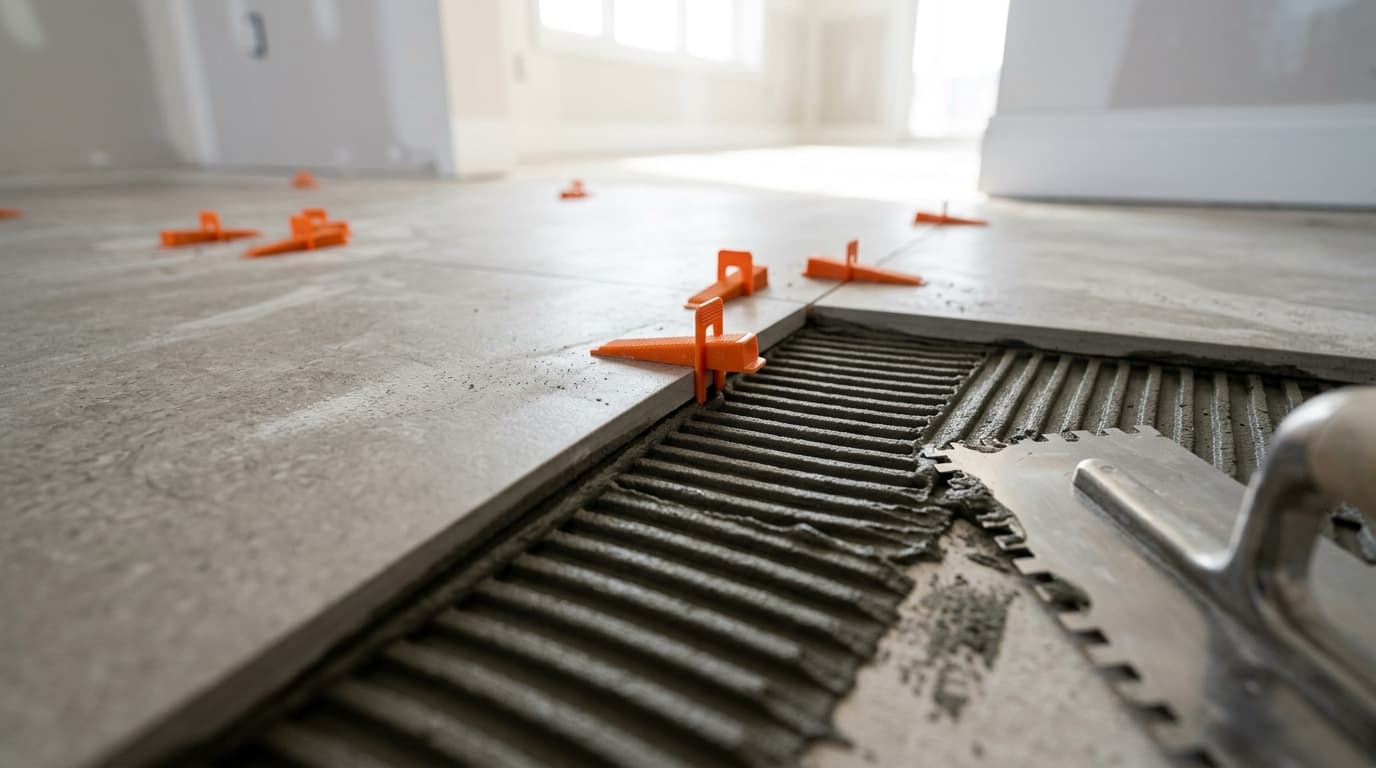
Tile Installation Cost: Ceramic vs. Porcelain vs. Stone, Materials, Labor & Budget Calculator
By Renovation Cost Lab Editorial · Last reviewed 2025-01-01
Tile is usually budgeted per square foot, combining tile material and labor, then adjusted for a waste factor and separate line items for substrate/backer board, waterproofing in wet areas, old-floor removal, and grout. Labor is typically the largest cost driver — more than the tile itself — because setting, leveling, cutting, and grouting are time-intensive. As an editable planning approach, multiply your room area by a combined per-square-foot rate, add roughly 10% for waste (more for diagonal or intricate patterns and large-format or stone tile), then add prep, waterproofing, removal, and grout allowances. Use the calculator with your own local quote for a real number — these are planning assumptions, not national averages.
Key cost factors
- Room square footage
- Tile type (ceramic vs. porcelain vs. natural stone)
- Labor rate (the biggest driver) and tile size/format
- Substrate and backer board / underlayment
- Waterproofing in wet areas (showers, bathrooms)
- Layout and pattern waste plus grout, sealing, and removal
Quick Cost Overview
Tile pricing is driven by how many square feet you are covering, the type of tile you choose, and — most of all — labor. Unlike click-together floors, tile is set piece by piece in thinset, leveled, cut around obstacles, then grouted, so the installation is labor-intensive and labor usually costs more than the tile itself.
On top of tile and labor you add line items for the substrate and backer board, waterproofing in wet areas, removing the old floor, and grout and sealing. Our calculator models a combined tile-plus-labor rate per square foot, a waste factor applied to the material, and optional allowances for substrate, waterproofing, removal, and grout. Every unit price is an editable planning assumption — replace it with a local quote for accuracy.
Ceramic vs. Porcelain vs. Natural Stone
The tile type you choose affects material cost, how hard it is to cut and set (which feeds back into labor), and maintenance. None is universally "best" — they suit different budgets and rooms.
| Factor | Ceramic | Porcelain | Natural stone |
|---|---|---|---|
| Make-up | Fired clay, often glazed | Denser fired clay, lower water absorption | Quarried stone (marble, travertine, slate, etc.) |
| Water resistance | Good when glazed | Very low absorption; strong for wet areas | Varies by stone; many need sealing |
| Cutting / install effort | Easier to cut | Harder/denser; often needs wet saw | Heavy; careful handling and setting |
| Sealing | Glazed usually not sealed (grout is) | Usually not sealed (grout is) | Typically needs periodic sealing |
| Editable material planning range | ~$1.00-$6.00 / sq ft | ~$2.00-$8.00 / sq ft | ~$5.00-$20.00+ / sq ft |
These ranges are editable planning assumptions, not quotes. Designer lines, large-format tiles, and premium stone push the top of each range well higher; adjust to your own local pricing.
Cost Components
A realistic tile budget is a sum of parts, not a single number. These are editable planning ranges — adjust each to match your own quote:
| Component | How it is measured | Editable planning range | Notes |
|---|---|---|---|
| Tile (material) | Per square foot | ~$1.00-$20.00+ / sq ft | Ceramic cheapest; natural stone highest |
| Labor (setting) | Per square foot | ~$4.00-$12.00 / sq ft | Usually the biggest driver; patterns and stone raise it |
| Substrate / backer board | Per square foot | ~$1.00-$3.00 / sq ft | Cement board or uncoupling membrane over the subfloor |
| Waterproofing (wet areas) | Per square foot or flat fee | ~$1.00-$4.00 / sq ft | Membranes in showers, tub surrounds, bathrooms |
| Grout & sealing | Per square foot or flat fee | ~$0.50-$1.50 / sq ft | Grout plus sealing for grout and/or stone |
| Removal & disposal | Per square foot or flat fee | ~$1.00-$3.00 / sq ft | Removing existing tile can be labor-heavy and dusty |
Because these components stack — and labor dominates — two rooms of the same size can land at very different totals once pattern complexity, waterproofing, and removal are included.
Substrate & Backer Board
Tile is rigid and brittle, so it needs a stable, stiff base. A floor that flexes will crack tiles or grout. Over a wood subfloor, that usually means installing cement backer board or an uncoupling membrane before setting tile, rather than tiling directly onto plywood. Over concrete, the slab itself may be the substrate if it is sound, flat, and crack-free, though uncoupling membranes are often used to manage movement.
Flatness matters: high spots and dips cause lippage (uneven tile edges) and hollow spots. Budget for self-leveling compound or patching if the substrate is uneven — like subfloor prep in any flooring job, it is a commonly underestimated line item. Deflection (how much the floor structure flexes under load) also matters; floors that are too springy may need added stiffening before tile, which is a structural question worth confirming for large-format tile and stone.
Waterproofing in Wet Areas & Safety Notes
Tile is water-resistant, but grout joints and the assembly behind the tile are not inherently waterproof. In showers, tub surrounds, and bathroom floors, a dedicated waterproofing layer — a liquid-applied or sheet membrane — protects the structure behind and below the tile from moisture that passes through grout. Skipping or shortcutting waterproofing is a leading cause of hidden rot and mold that only shows up after an expensive failure.
Treat wet-area waterproofing as a required line item, not an optional upgrade, and follow the membrane manufacturer's system (including seams, corners, and penetrations). If you are tiling a shower or wet room and are unsure about the waterproofing assembly, this is a good place to use a professional. Where you suspect existing water damage, rot, or mold behind old tile, stop and have it assessed before covering it back up.
Layout, Pattern & Waste Factor
You always buy more tile than the room's measured area, because tiles are cut to fit walls and obstacles, some cuts cannot be reused, and a few tiles may arrive chipped. A common starting point is about 10% extra for a straightforward straight or grid layout in rectangular rooms.
Waste varies by pattern and material. Diagonal layouts push waste higher, and intricate patterns — herringbone, pinwheel, or mixed-size designs — can require noticeably more because of the angled and partial cuts. Large-format tile raises waste because an off-cut wastes a big piece, and natural stone raises it further because of variation and the chance of flaws. Keep some attic stock from the same lot for future repairs, since replacement tile may not match the color or batch.
DIY vs. Professional
A small, simple floor on a sound substrate is within reach for a careful DIYer with a wet saw, trowel, spacers, and patience. The honest trade-offs are time, the learning curve on thinset and lippage, and the fact that substrate or waterproofing mistakes are expensive to fix after the tile is down.
Large areas, intricate patterns, large-format tile, natural stone, and especially wet-area waterproofing (showers and wet rooms) are where professional experience pays off. Pros also handle demolition of old tile, substrate correction, and movement joints — details that determine whether a floor lasts or cracks.
Common Budget Mistakes
- Budgeting only tile-plus-labor and forgetting substrate, waterproofing, grout, and removal.
- Underestimating labor — on tile it is usually the single biggest cost, not an afterthought.
- Tiling directly over plywood or a flexing floor instead of installing proper backer board or membrane.
- Treating waterproofing as optional in a shower or bathroom and paying later for hidden rot or mold.
- Using a straight-lay waste factor for a diagonal, herringbone, large-format, or stone job that needs more.
- Forgetting that natural stone and many grouts need periodic sealing.
- Treating a national "average" as your quote. Always confirm locally.
Estimate your project
Adjust the inputs to match your project and local prices.
Add a row per room. For irregular rooms, enter an equivalent length × width that matches the measured area.
Leave 0 to use the material default.
Extra material for cuts. Diagonal / herringbone patterns need more; tile typically higher than carpet.
Adds $1.50/sq ft for tear-out and disposal.
Adds $0.55/sq ft of underlayment / padding.
Leave 0 to use the material default.
Frequently asked questions
- How is tile installation priced?
- Most commonly per square foot, combining tile and labor, then adjusted upward for a waste factor and separate line items for substrate/backer board, waterproofing in wet areas, grout and sealing, and old-floor removal. Labor is usually the biggest driver. Our calculator lets you model each of these with your own editable prices.
- Why is tile labor so expensive compared to the tile itself?
- Because tile is set one piece at a time in thinset, leveled to avoid lippage, cut to fit walls and obstacles, then grouted and often sealed. That is slow, skilled work, so labor commonly exceeds the material cost — especially for intricate patterns, large-format tile, and natural stone.
- Do I always need waterproofing under tile?
- Not for every floor, but you should treat it as required in wet areas — showers, tub surrounds, and bathroom floors. Tile and grout are water-resistant, not waterproof, so a dedicated membrane protects the structure behind and below from moisture. Skipping it is a common cause of hidden rot and mold. In a dry living area over a sound substrate, a waterproofing membrane is usually not needed, though a crack-isolation or uncoupling membrane may still be used.
Sources & pricing methodology
- Renovation Cost Lab editable demonstration datasetDefault unit prices and waste factors are reasonable planning assumptions, not verified national averages. See our pricing methodology.
- Tile Council of North America (general reference)General educational reference for substrate, movement, and waterproofing concepts; always follow the specific installation methods and warranty terms for the products you buy.https://www.tcnatile.com/
See our full pricing methodology and editorial policy.