
Popcorn Ceiling Removal Cost: Scraping, Refinish & Asbestos
By Renovation Cost Lab Editorial · Last reviewed 2025-01-01
Popcorn ceiling removal is usually budgeted per square foot of ceiling area and scales with room size. The scraping is only part of the job: the ceiling almost always needs a skim-coat or retexture and a repaint afterward, which adds significant cost. Critically, popcorn texture in homes built before the 1980s may contain asbestos — it must be tested before anyone scrapes, and a positive result means professional abatement, not DIY. These are editable planning figures, not national averages — adjust to local quotes.
Key cost factors
- Ceiling square footage (the main driver)
- Asbestos testing and, if positive, professional abatement (pre-1980s homes)
- Whether the texture is painted (painted popcorn is harder to remove)
- Refinishing level after scraping (skim-coat vs. new texture)
- Repainting the ceiling after refinishing
- Ceiling height, obstructions, and furniture/floor protection
Quick Cost Overview
Popcorn ceiling removal is priced per square foot of ceiling area and scales directly with room size. But the headline scraping price is misleading on its own: the real project is scrape, refinish, repaint, and the finishing steps often cost as much as the removal.
Before any of that, there is a gating question for older homes — whether the texture contains asbestos. That single test can change the project from a weekend DIY job into a regulated professional abatement. Every figure here is an editable planning assumption; adjust it to your local quote.
Asbestos Caution: Test Before You Scrape (Pre-1980s Homes)
This is the most important section on the page. Popcorn (acoustic) ceiling texture applied in homes built before the 1980s may contain asbestos. Intact, painted-over texture is generally not a hazard — but scraping it is exactly the kind of disturbance that releases asbestos fibers into the air, and those fibers are a serious long-term health hazard.
- Test first. For any home from before the mid-1980s, have the texture tested by a qualified lab or professional before anyone touches it. A small sample is inexpensive relative to the risk.
- If the test is positive: do not scrape it yourself. Asbestos removal is regulated and must be handled by a licensed abatement professional, which costs substantially more than ordinary removal. An alternative to removal is encapsulating or covering the ceiling (for example, with new drywall over it) so the texture is never disturbed.
- If the test is negative: you can proceed with standard removal and finishing.
Do not skip the test to save time or money. The cost of testing is trivial next to the cost — financial and health — of disturbing asbestos.
Cost Drivers and Breakdown
Once asbestos is ruled out (or professionally abated), these factors drive the price:
| Cost driver | Effect on the budget |
|---|---|
| Ceiling square footage | The main driver — cost scales with area |
| Painted vs. unpainted texture | Painted popcorn resists water and is much harder/slower to scrape |
| Refinishing level | A skim-coat to smooth is standard; a new sprayed texture costs more |
| Repainting | Ceilings are primed and painted after refinishing — a separate line |
| Ceiling height & access | High or vaulted ceilings need scaffolding and are slower |
| Protection & cleanup | Masking floors, walls, and fixtures; hauling wet debris |
Painted popcorn is a common budget surprise: paint seals the texture so it will not soften with water, which is the usual trick for easy scraping. That can mean sanding or a more aggressive method, raising the cost.
The Process: Scrape, Refinish, Repaint
Removal is three distinct stages, and a quote should be clear about all three:
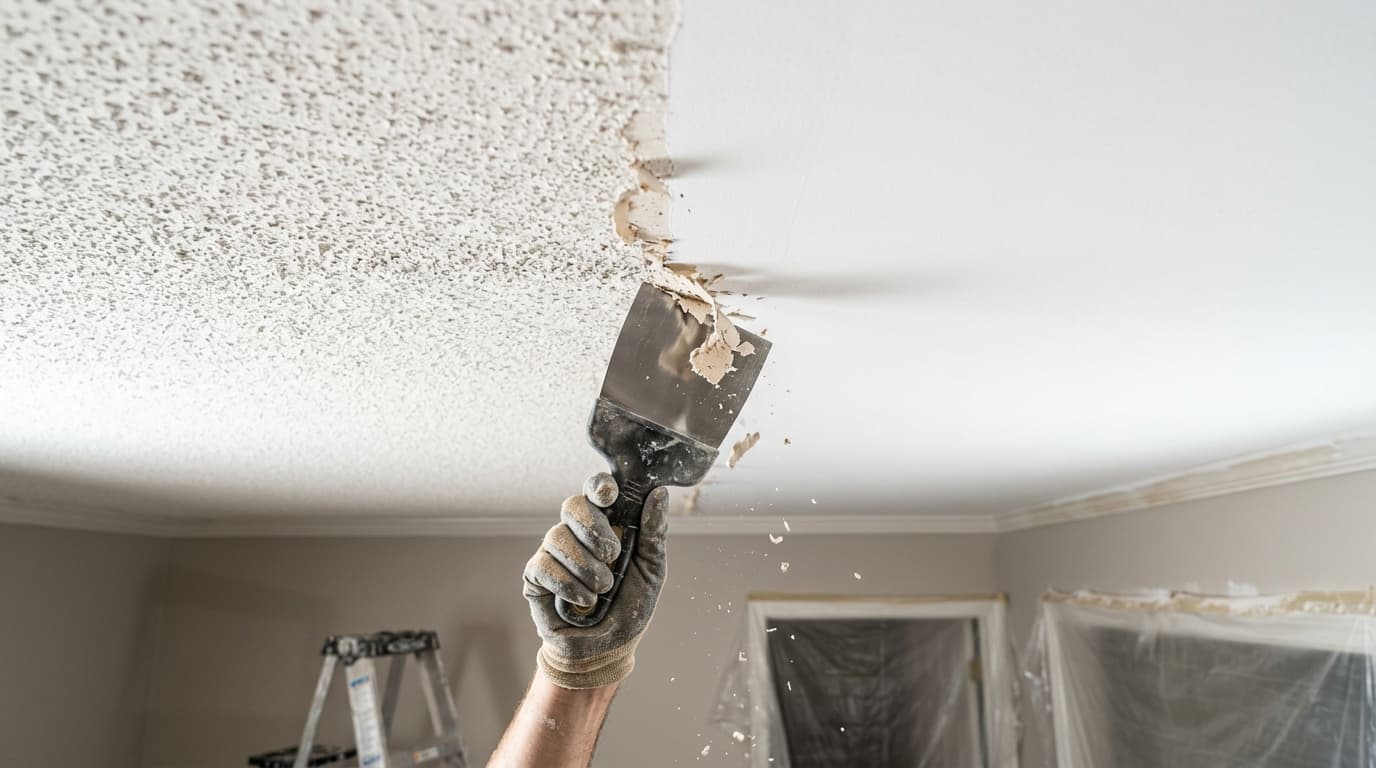
- Scrape. Unpainted texture is misted with water to soften it, then scraped off. This is the messy stage — wet texture comes down in sheets and goes everywhere.
- Refinish. Scraping leaves a rough, gouged surface. The ceiling is skim-coated and sanded smooth (or sprayed with a new texture like knockdown). This is skilled drywall finishing, closely related to patch work.
- Repaint. The bare, refinished ceiling is primed and painted. Budget this the way you would any ceiling paint job.
Because refinishing is drywall work, the same texture-matching and flat-finish skills that matter for drywall repair apply here. Plan the repaint as its own cost alongside the scraping.
DIY vs. Professional
Assuming a negative asbestos test, scraping unpainted popcorn is physically doable for a determined DIYer — but understand the mess factor. Wet, scraped texture lands on everything, so the room must be fully sheeted — floors, walls, and any remaining fixtures — and the work is overhead, slow, and tiring. The hard part for most homeowners is not the scraping but the refinishing: getting a ceiling perfectly flat and flash-free is unforgiving, and ceilings show every imperfection under raking light.
A professional earns the fee on refinishing quality, high ceilings, painted texture that resists scraping, and doing the whole thing quickly with proper containment. If the texture is painted, the ceiling is high, or you want a flawless smooth finish, a pro is usually the better value.
Common Budget Mistakes
- Skipping the asbestos test in a pre-1980s home — the single most dangerous and costly mistake.
- Budgeting only for scraping and forgetting the skim-coat/retexture and repaint that follow.
- Assuming the texture will mist and scrape easily when it is actually painted over.
- Underestimating the mess and the cost of protecting floors, walls, and fixtures.
- Expecting a flawless smooth ceiling from a first DIY attempt — refinishing is the skilled part.
- Treating a national "average" as your quote. Always confirm locally.
Frequently asked questions
- How is popcorn ceiling removal priced?
- Per square foot of ceiling area, scaling with room size. The quote should cover three stages — scraping, refinishing (skim-coat or new texture), and repainting — because the scraping alone leaves a rough surface that still needs finishing and paint. In older homes, asbestos testing (and possibly abatement) is a separate, gating cost.
- Do I need to test for asbestos before removing a popcorn ceiling?
- If your home was built before the mid-1980s, yes — test the texture before anyone scrapes it. Popcorn texture from that era may contain asbestos, and scraping releases fibers that are a serious health hazard. A positive result means licensed professional abatement, not DIY; a negative result lets you proceed with standard removal.
- Can I remove a popcorn ceiling myself?
- Only after a negative asbestos test. Scraping unpainted texture is doable but extremely messy, so the room must be fully protected. The harder part is refinishing — ceilings show every flaw — and painted popcorn resists the water-and-scrape method entirely. For high ceilings, painted texture, or a flawless finish, a professional is usually the better choice.
Sources & pricing methodology
- Renovation Cost Lab editable demonstration datasetDefault per-square-foot and refinishing figures are reasonable planning assumptions, not verified national averages. See our pricing methodology.
- EPA — Asbestos in the home (general reference)General reference on asbestos safety and testing; always confirm current guidance and use qualified professionals for testing and abatement.https://www.epa.gov/asbestos/protect-your-family-exposures-asbestos
See our full pricing methodology and editorial policy.