
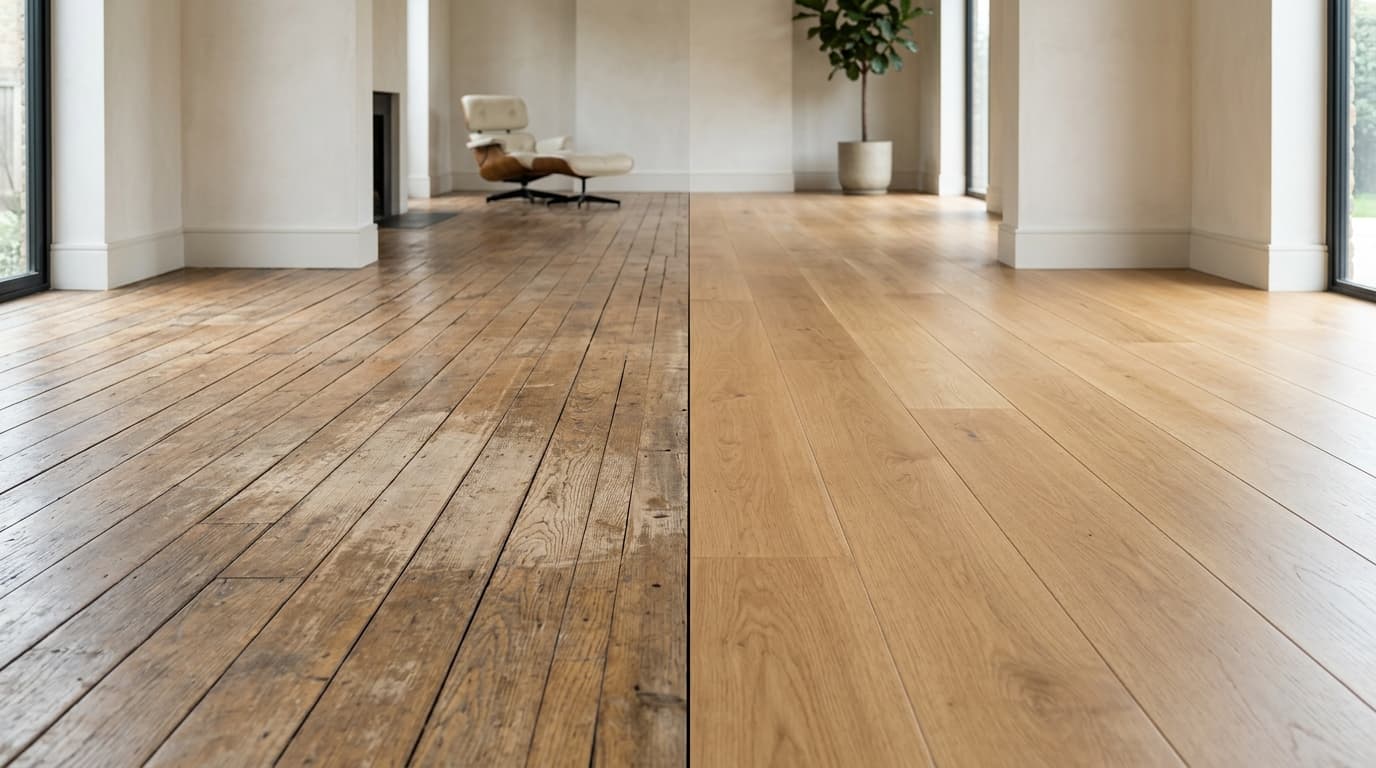
Repair, Refinish, or Replace Flooring? How to Decide
By Renovation Cost Lab Editorial · Last reviewed 2025-01-01
There is no universal rule. Whether to refinish, spot-repair, or fully replace flooring depends on the material, what is actually wrong, whether the subfloor is sound, and how your quotes compare — not a single threshold. Surface wear on solid hardwood that still has thickness to sand often favors refinishing; isolated damage favors a spot repair; water-damaged subfloor, worn-through wear layers, or material at the end of its life often favor replacement. Because hidden subfloor and moisture damage change everything, confirm the condition first. Then enter your own repair/refinish quote, replacement quote, and realistic remaining years into the annualized cost calculator.
Key cost factors
- Flooring material (solid hardwood, engineered, laminate, LVP, tile)
- What is wrong — surface wear vs. deep gouges, water, or structural damage
- For hardwood, whether enough thickness remains to sand and refinish
- Condition of the subfloor underneath
- Whether damage is isolated or widespread
- Refinish/repair cost vs. replacement cost, and the years each buys
Quick Answer
There is no one rule that answers this for every floor. The decision depends on the material, what is actually wrong (surface wear versus deep or water damage), whether the subfloor is sound, and how your repair/refinish and replacement quotes compare.
Material matters a lot here. Solid hardwood can often be sanded and refinished when its wear remains, which can reset its appearance for far less than replacement. Many laminate and luxury vinyl plank (LVP) products cannot be refinished — a damaged plank is usually swapped or the floor replaced. And water or subfloor damage can turn any "simple" refinish into a replacement.
Put your own figures into the annualized cost calculator: your repair/refinish quote, your replacement quote, and an honest estimate of how many more years each path buys. Comparing cost per year of service beats any rule of thumb.
When Repair or Refinish Usually Makes Sense
Repair or refinish tends to be the stronger choice when the problem is at the surface and the floor is otherwise sound:
- Solid hardwood with surface wear — scratches, dullness, light scuffing — that still has enough thickness above the tongue to be sanded and refinished. Refinishing can restore the look for a fraction of replacement.
- Isolated damage — a few gouged boards, a cracked tile, or a damaged plank — that can be spot-repaired or swapped without redoing the whole floor.
- The subfloor underneath is dry and sound, with no soft spots, movement, or signs of moisture.
- The repair or refinish is modest relative to replacement and buys several more years of service.
In these cases refinishing or repair often costs far less per year of remaining service than tearing out and replacing. Confirm both the material's refinish potential and the subfloor before assuming it.
When Replacement Usually Makes Sense
Replacement tends to be the stronger choice when the floor or what is under it has reached the end of its practical life:
- Water-damaged or structurally compromised subfloor — soft spots, movement, buckling, or signs of rot or mold. Surface work over a bad subfloor only hides the problem.
- Hardwood that has been sanded as far as it safely can — once the wear is near the tongue, there is not enough material to refinish again.
- Flooring that cannot be refinished (most laminate and LVP) and is worn through its wear layer across the room.
- Widespread damage rather than an isolated board or tile, or repairs you keep repeating.
- You want a different material or layout that repair cannot deliver.
Here replacement often wins on annualized cost because it buys many more years of service and lets you address the subfloor properly, even at a higher upfront price.
How to Compare Costs Fairly
The fairest way to compare the paths is annualized cost: the total cost of a path divided by the number of usable years it buys.
Annualized cost = total path cost / usable years.
- Repair/refinish path: the refinish or repair quote (plus any repairs you realistically expect soon) divided by the remaining years you expect from the existing floor.
- Replacement path: the installed price of the new floor divided by the years you expect from it.
Whichever path has the lower cost per year is generally the better value. Conceptually, there is a break-even point — if refinishing buys enough added years that its cost-per-year drops below the replacement's cost-per-year, refinishing wins; if not, replacement wins. For hardwood, the honest "usable years" estimate depends partly on how much thickness is left to sand again in the future.
You will sometimes hear a rough heuristic such as "refinish if it costs much less than replacing and the floor can still be sanded." Treat that only as a rough starting point, not a rule — it ignores subfloor condition, material type, and how many years each path actually buys. The annualized comparison is the honest version; use the calculator to run it with your numbers.
| Leans toward repair/refinish | Leans toward replace |
|---|---|
| Solid hardwood with thickness left to sand | Hardwood sanded near the tongue; no material left |
| Surface wear or isolated damage | Widespread or worn-through damage |
| Subfloor dry and sound | Water-damaged or soft subfloor |
| Material can be refinished or spot-repaired | Material cannot be refinished (most laminate/LVP) |
| Refinish is modest vs. replacement | Repair approaches or exceeds replacement cost |
Factors Beyond Cost
Money is only part of the decision. Weigh these alongside the annualized comparison:
- Subfloor and moisture: an unresolved moisture or subfloor problem can spread and damage more than the finish floor — address the cause, not just the surface.
- Refinish limits: solid hardwood can be refinished a finite number of times; engineered wood only if its wear is thick enough; most laminate and LVP not at all.
- Matching: a spot repair may not perfectly match aged or discontinued flooring; whether that matters is up to you.
- Disruption and health: refinishing involves dust and fumes, and older floors or adhesives may warrant caution — see the safety notes.
Safety & Code Notes
Most flooring work is lower-risk than structural or gas work, but a few things warrant care:
- Moisture and mold: if you find a soft, buckled, or discolored floor, treat the subfloor and any moisture source before refinishing or recovering. Hidden mold is a health issue, not just a cosmetic one.
- Older materials: some older resilient flooring, backing, and adhesives (common in homes built before the late 1980s) may contain asbestos. Do not sand, grind, or aggressively remove old flooring without having it evaluated first.
- Refinishing dust and fumes: sanding produces fine dust and finishes can release strong fumes — ventilate, protect yourself, and follow product instructions, or use a professional.
- Permits are usually not required for a like-for-like floor covering, but related subfloor or structural repairs may be. Check your local building department.
If you suspect water damage to the subfloor, mold, or asbestos-containing material, stop and bring in a qualified professional before deciding anything.
Estimate your project
Adjust the inputs to match your project and local prices.
How many more years of use the repair realistically buys. Your estimate.
Expected usable years of the new unit. Your estimate.
e.g. extra energy cost of keeping an inefficient old unit.
The period you want to think over. If it exceeds the added repair years, you will be warned.
Frequently asked questions
- How do I decide whether to refinish, repair, or replace my flooring?
- There is no single rule. Weigh the material, what is actually wrong, whether the subfloor is sound, and how your quotes compare. Confirm the condition first — especially the subfloor and, for hardwood, how much thickness is left to sand. Then compare the annualized cost of each path, total cost divided by usable years, using your own quotes in the calculator.
- Is it cheaper to refinish hardwood than replace it?
- Often, yes — when the hardwood still has enough thickness to sand and the subfloor is sound, refinishing typically costs much less than a full tear-out and replacement and can restore the look. But once the wear is sanded near the tongue, or if the subfloor is water-damaged, replacement may be the only real option. Compare the annualized cost of each path with your own numbers.
- Can laminate or luxury vinyl plank (LVP) be refinished?
- Generally no. Most laminate and LVP have a printed wear layer that cannot be sanded and refinished like solid wood. Isolated damage is usually handled by replacing the affected planks, and once the wear layer is worn through across a room, replacement is typically the path forward.
Sources & pricing methodology
- Renovation Cost Lab user-input cost modelThis topic does not bundle fixed prices. The decision tool uses the refinish/repair quote, replacement quote, and expected usable years that YOU enter to compute and compare annualized cost. There are no national averages implied.
- General flooring and material safety referenceGeneral educational reference only. Refinish potential, subfloor condition, asbestos handling in older materials, and permit rules vary by product and jurisdiction — have moisture, subfloor, and older-material concerns evaluated by a qualified professional and follow your local code.
See our full pricing methodology and editorial policy.