
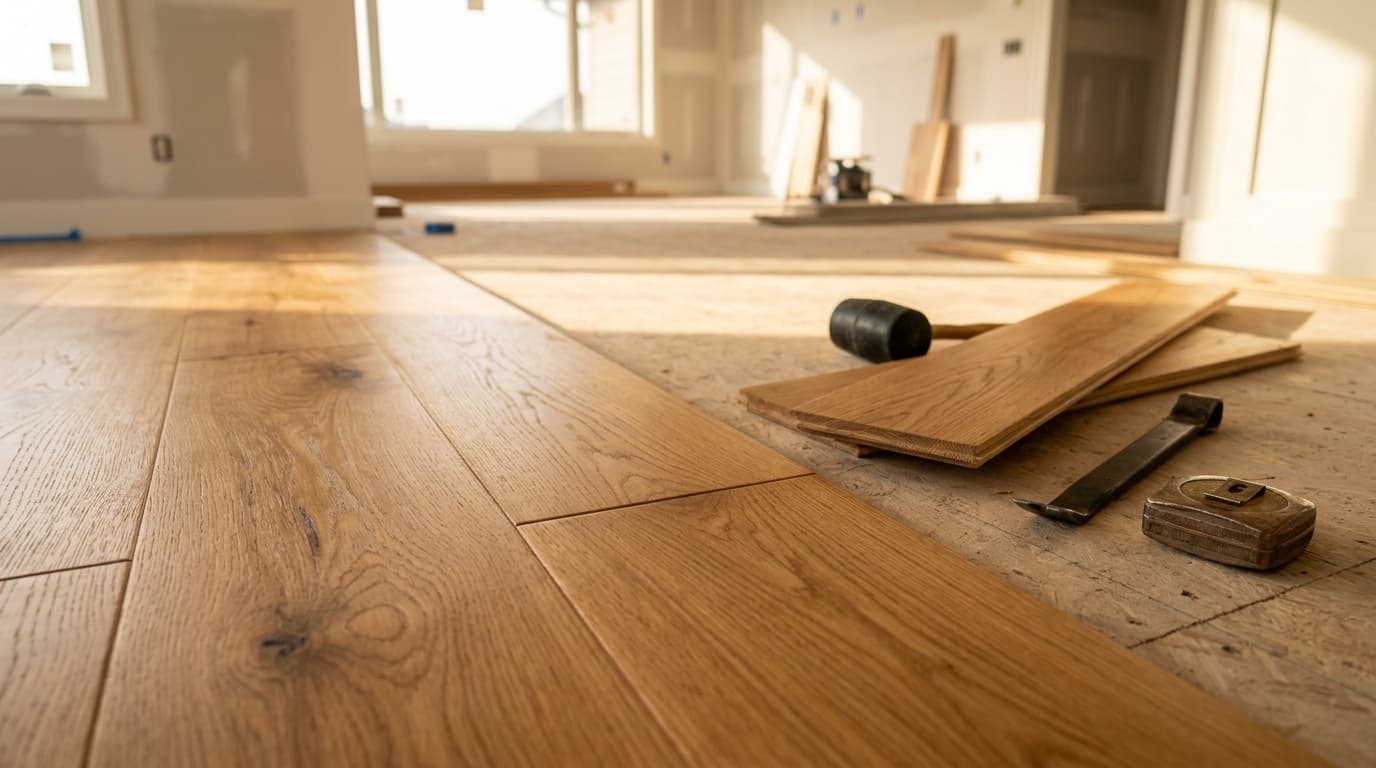
Hardwood Floor Installation Cost: Solid vs. Engineered, Materials, Labor & Budget Calculator
By Renovation Cost Lab Editorial · Last reviewed 2025-01-01
Hardwood flooring is usually budgeted per square foot, combining material and labor, then adjusted for a waste factor and separate line items for subfloor prep, old-floor removal, and underlayment where needed. As an editable planning approach, multiply your room area by a combined per-square-foot rate, add roughly 5-10% for waste (more for diagonal or herringbone layouts or wide planks), then add prep, removal, and finishing allowances. Solid and engineered wood differ in installation method and where they can go; site-finished floors add sand-and-finish labor that prefinished planks avoid. Use the calculator with your own local quote for a real number — these are planning assumptions, not national averages.
Key cost factors
- Room square footage
- Solid vs. engineered and board width
- Species and grade of the wood
- Site-finished vs. prefinished (sand-and-finish labor)
- Labor rate, install method, and subfloor prep/acclimation
- Waste factor (pattern and plank width driven) plus old-floor removal
Quick Cost Overview
Hardwood installation pricing comes down to a few things: how many square feet you are covering, whether you choose solid or engineered wood, the species and grade of the boards, your installer's labor rate, and how the floor is finished. On top of that you add line items for subfloor preparation, removing the old floor, and — for site-finished floors — the sanding and finishing labor.
Our calculator models a combined material-plus-labor rate per square foot, a waste factor applied to the material, and optional allowances for subfloor prep, removal, and finishing. Every unit price is an editable planning assumption — replace it with a local quote for accuracy.
Solid vs. Engineered Hardwood
The first decision is solid versus engineered, because it affects material cost, where the floor can go, and how it is installed. Neither is universally "better" — they suit different situations.
| Factor | Solid hardwood | Engineered hardwood |
|---|---|---|
| Construction | One solid piece of wood throughout | Real wood veneer over a plywood/HDF core |
| Typical install | Nailed/stapled to a wood subfloor | Nail, glue, or float depending on product |
| Over concrete / below grade | Generally not recommended | Often suitable (follow manufacturer specs) |
| Refinishing | Can be sanded and refinished multiple times | Limited by veneer thickness; some cannot be refinished |
| Editable material planning range | ~$4.00-$10.00 / sq ft | ~$3.50-$9.00 / sq ft |
These ranges are editable planning assumptions, not quotes. Exotic species, wide planks, and premium grades push the top of each range higher; adjust to your own local pricing.
Cost Components
A realistic hardwood budget is a sum of parts, not a single number. These are editable planning ranges — adjust each to match your own quote:
| Component | How it is measured | Editable planning range | Notes |
|---|---|---|---|
| Material (boards) | Per square foot | ~$3.50-$10.00 / sq ft | Solid vs. engineered, species, grade, and width drive the spread |
| Labor (install) | Per square foot | ~$3.00-$8.00 / sq ft | Nail-down and glue-down cost more than floating |
| Site-finishing (if applicable) | Per square foot | ~$2.00-$5.00 / sq ft | Sand-and-finish labor; skip for prefinished boards |
| Underlayment / moisture barrier | Per square foot | ~$0.30-$1.00 / sq ft | Product- and subfloor-dependent |
| Subfloor prep | Per square foot or flat fee | ~$0.50-$2.50 / sq ft | Leveling, patching, or added plywood as needed |
| Removal & disposal | Per square foot or flat fee | ~$0.50-$2.00 / sq ft | Varies with existing floor type and fasteners |
Because these components stack, two rooms of the same size can land at very different totals once finishing, prep, and removal are included. Labor and finishing together often rival or exceed the material cost.
Species, Grade & Finish Method
Species affects both price and performance. Domestic options like oak, maple, and hickory are widely available; exotic and imported species typically cost more. Harder species resist denting better, but hardness is only one factor in how a floor wears.
Grade describes the appearance and consistency of the boards — clearer, more uniform grades cost more, while rustic or character grades show more knots and color variation and are usually cheaper. Grade is an aesthetic and price choice, not a measure of structural quality.
Finish method is a major cost fork. Prefinished boards arrive sanded and factory-coated, so installation skips the sanding step and the floor is usually walkable sooner. Site-finished floors are installed raw, then sanded and finished in place — this adds labor and dry time but allows a seamless surface, custom stain, and the ability to blend transitions. Budget the sand-and-finish labor as its own line item when you choose site-finished.
Subfloor Prep, Acclimation & Structural Notes
Wood moves with moisture, so preparation matters more with hardwood than with many other floors. Two things dominate: subfloor condition and acclimation.
The subfloor should be structurally sound, clean, dry, and flat to the manufacturer's tolerance (often around 3/16" over 10 feet). Nail-down solid wood generally needs a suitable wood subfloor; installing over concrete usually points you toward engineered products and a moisture barrier. A moisture test on slabs and in basements is a standard, inexpensive safeguard. If the subfloor is uneven, budget for leveling compound, patching, or an added plywood layer — this is one of the most commonly underestimated line items.
Acclimation: wood flooring typically needs to sit in the installation space for a period (follow the manufacturer's instructions) so its moisture content equalizes with the room. Skipping acclimation is a frequent cause of gapping, cupping, or buckling later. If you suspect structural issues — sagging joists, active leaks, or rot — stop and have them assessed by a qualified professional before installing a floor on top.
Waste Factor Explained
You always buy more material than the room's measured area, because boards are cut to fit walls, doorways, and obstacles, and off-cuts and defective boards cannot all be reused. A common starting point is 5-10% extra for a straightforward straight-lay in rectangular rooms.
Waste varies by pattern and material. Diagonal layouts push waste higher, and herringbone or chevron patterns can require noticeably more because of the angled cuts and layout geometry. Wider planks, long runs that need board matching, racking to avoid repetitive grain, and rooms with many jogs or closets also raise waste. It is wise to keep some attic stock from the same lot for future repairs, since later boards may not match the color exactly.
DIY vs. Professional
Floating engineered floors are the most DIY-approachable hardwood option: with careful measuring, the right tools, and patience, some homeowners install them and save on labor. The trade-offs are time, the learning curve on cuts and transitions, and the fact that layout or acclimation mistakes show up later.
Nail-down solid wood, glue-down installs, large open areas, patterns like herringbone, and especially site-finishing (which involves drum/orbital sanders and finish chemistry) are generally better left to professionals. A pro also typically handles removal, disposal, moisture testing, and warranty-compliant prep.
The Refinish Option
If you already have solid hardwood — or thick-veneer engineered wood — refinishing can be far cheaper than replacing. Sanding back to bare wood and applying new finish restores a worn floor without the cost of new material or removal, and solid floors can usually be refinished several times over their life.
Refinishing is budgeted per square foot for sand-and-finish labor plus materials, with optional stain. It is not always an option: thin-veneer engineered floors may not have enough wear layer to sand, and floors with deep damage, water staining, or structural problems may need replacement instead. When refinishing is viable, compare it against replacement before assuming you need a new floor.
Common Budget Mistakes
- Budgeting only material-plus-labor and forgetting waste, finishing, prep, and removal.
- Forgetting that site-finished floors add a separate sand-and-finish labor line item.
- Using a straight-lay waste factor for a diagonal or herringbone layout that needs more.
- Skipping acclimation or moisture testing, then paying for gapping, cupping, or buckling.
- Trying to install solid nail-down wood over concrete or below grade where engineered is the appropriate choice.
- Replacing a floor that could have been refinished for a fraction of the cost.
- Treating a national "average" as your quote. Always confirm locally.
Estimate your project
Adjust the inputs to match your project and local prices.
Add a row per room. For irregular rooms, enter an equivalent length × width that matches the measured area.
Leave 0 to use the material default.
Extra material for cuts. Diagonal / herringbone patterns need more; tile typically higher than carpet.
Adds $1.50/sq ft for tear-out and disposal.
Adds $0.55/sq ft of underlayment / padding.
Leave 0 to use the material default.
Frequently asked questions
- How is hardwood floor installation priced?
- Most commonly per square foot, combining material and labor, then adjusted upward for a waste factor and separate line items for subfloor prep, old-floor removal, underlayment, and — for site-finished floors — sanding and finishing. Our calculator lets you model each of these with your own editable prices.
- Should I choose solid or engineered hardwood?
- It depends on where the floor is going and how you plan to maintain it. Solid wood can be refinished many times and is typically nailed to a wood subfloor, but is generally not recommended over concrete or below grade. Engineered wood is more versatile — it can often be glued or floated over concrete — though thin-veneer products may not be refinishable. Match the product to your subfloor and follow the manufacturer's instructions.
- Is site-finished or prefinished hardwood cheaper?
- Prefinished boards avoid on-site sanding and finishing labor, so the installed job is often simpler and faster, and the room is usually walkable sooner. Site-finished floors add a sand-and-finish labor line item but allow a seamless surface and custom stain. Compare the total installed cost — including that finishing labor — rather than the board price alone.
Sources & pricing methodology
- Renovation Cost Lab editable demonstration datasetDefault unit prices and waste factors are reasonable planning assumptions, not verified national averages. See our pricing methodology.
- National Wood Flooring Association (general reference)General educational reference for subfloor, acclimation, and installation concepts; always follow the specific instructions and warranty terms for the product you buy.https://www.woodfloors.org/
See our full pricing methodology and editorial policy.