
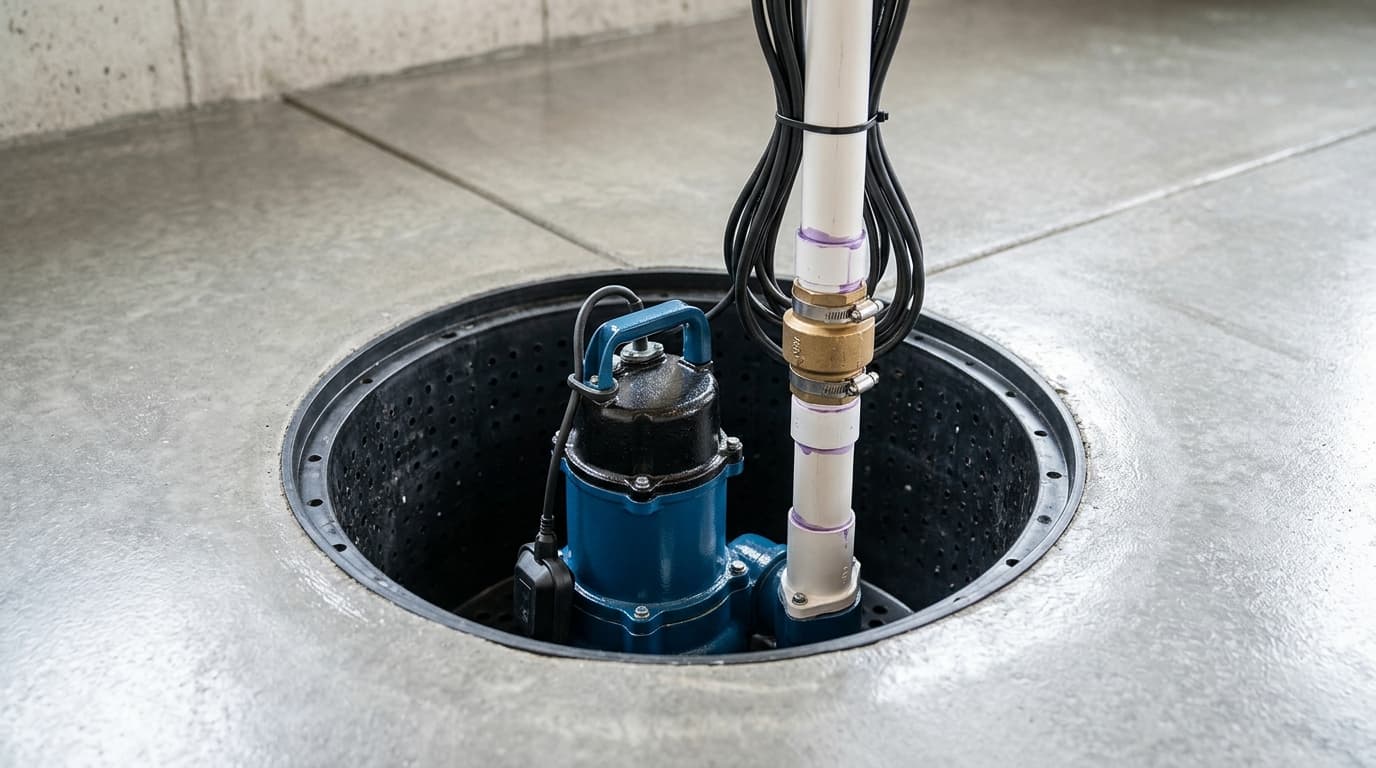
Sump Pump Installation Cost: Pedestal vs. Submersible, Basin & Backup
By Renovation Cost Lab Editorial · Last reviewed 2025-01-01
Sump pump installation cost is driven by the pump type, whether a basin/pit already exists, and add-ons like a battery backup and discharge line. As an editable planning range, a pedestal pump is usually the cheapest unit, a submersible costs more, and a battery backup adds a meaningful line item. Cutting a new pit into the slab and running dedicated electrical push the price up. Treat every figure here as a planning assumption and adjust to local quotes — these are not national averages.
Key cost factors
- Pump type (pedestal vs. submersible)
- Whether a basin/pit already exists or must be cut into the slab
- Battery backup (and whether a secondary pump is added)
- Discharge line length and routing to daylight
- Electrical work (dedicated circuit, GFCI protection)
- Pump horsepower/capacity for the water volume
Quick Cost Overview
Sump pump cost starts with the pump itself, but the install can cost as much as or more than the unit. The biggest variables are whether a basin (pit) already exists, whether you add a battery backup, and how far the discharge line has to run.
If a pit and electrical outlet are already in place, swapping a pump is relatively inexpensive. Cutting a new pit into the slab and running a new circuit is a much larger job. Every figure below is an editable planning assumption — replace it with a local quote before you commit.
Cost Drivers and Component Breakdown
Price out the pieces separately to see where your money goes:
| Component | What it covers | Relative cost driver |
|---|---|---|
| Pump unit | Pedestal or submersible pump | Type and horsepower/capacity |
| Basin / pit | The reservoir the pump sits in | Existing pit is cheap; cutting a new one into concrete is costly |
| Battery backup | Keeps pumping during power outages | Battery and often a second pump; a notable add-on |
| Discharge line | Pipe carrying water out to daylight | Length, routing, and freeze protection |
| Electrical | Dedicated circuit and GFCI protection | Distance to panel; often requires a licensed electrician |
Because water and electricity meet at a sump pump, the electrical portion is frequently the part that turns a DIY swap into a job for a professional.
Pedestal vs. Submersible
Pedestal pumps keep the motor above the pit on a shaft. They are usually cheaper, easier to service, and tend to last a long time, but they are louder and more exposed.
Submersible pumps sit inside the basin underwater. They cost more and can be harder to access, but they are quieter, save space, and generally handle higher water volumes. For basements that flood frequently or take on a lot of water, submersible is often the choice despite the higher price.
DIY vs. Professional Installation
Replacing an existing submersible or pedestal pump in an existing pit with an existing outlet is a reasonable DIY task for a handy homeowner. The job becomes professional when it involves cutting the slab for a new pit, routing a long discharge line, or any new wiring.
Electrical work is the key dividing line: a sump pump should be on a properly protected circuit, and improper wiring around water is dangerous. Hire a qualified electrician for new circuits or GFCI work.
When a Professional Is Needed
Bring in professionals when the install requires a new dedicated circuit or GFCI protection (electrician), when the slab must be cut for a new pit, or when the discharge line needs careful routing to avoid freezing or discharging too close to the foundation.
Also treat a sump pump as part of a larger picture: if the basement has recurring water intrusion, visible mold, or any structural concern, have a qualified pro assess the underlying problem. A sump pump manages water that reaches the pit — it does not fix a leak or guarantee a dry basement on its own.
Common Budget Mistakes
- Budgeting for the pump only and forgetting the pit, discharge line, and electrical work.
- Skipping a battery backup, so the pump fails during the storms that cause outages.
- Discharging water too close to the foundation, where it simply returns.
- DIY-wiring a new circuit instead of hiring a licensed electrician.
- Treating a national "average" as your quote. Always confirm locally.
Frequently asked questions
- How is sump pump installation priced?
- It is typically the cost of the pump plus the install, where the install includes the basin/pit (existing or newly cut), the discharge line, any battery backup, and electrical work. A straight pump swap into an existing pit is far cheaper than a from-scratch installation.
- Do I need an electrician to install a sump pump?
- If an appropriate, protected outlet already exists you may not. But if the job requires a new dedicated circuit or GFCI protection, that electrical work should be done by a licensed electrician because of the water-and-electricity hazard.
- Does a sump pump guarantee a dry basement?
- No. A sump pump removes water that collects in the pit, but it does not stop leaks or address the source of water intrusion. Recurring water and any structural or mold concerns should be assessed by a qualified professional. We do not present a dry basement as guaranteed.
Sources & pricing methodology
- Renovation Cost Lab editable demonstration datasetDefault unit prices are reasonable planning assumptions, not verified national averages. See our pricing methodology.
- U.S. Environmental Protection Agency — flooding and moisture guidance (general reference)General educational reference for moisture and flooding concerns; consult qualified professionals for electrical and structural work.https://www.epa.gov/mold
See our full pricing methodology and editorial policy.