
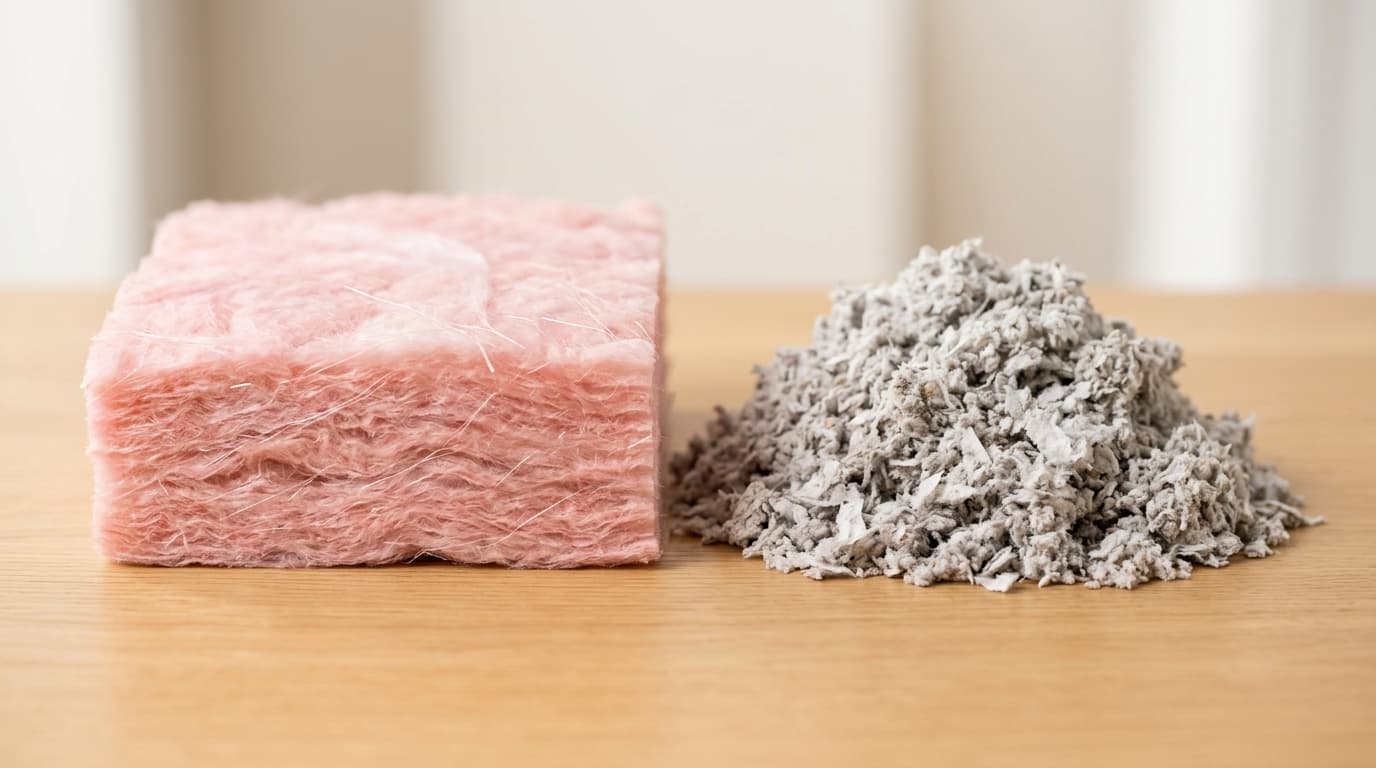
Fiberglass vs. Cellulose Insulation: Head-to-Head Comparison
By Renovation Cost Lab Editorial · Last reviewed 2025-01-01
Cellulose packs more R per inch (~3.5) than loose-fill fiberglass (~2.5), so it needs less depth for the same R-target, but it is denser, settles over time, and absorbs moisture more readily. Fiberglass is lighter, does not feed mold, and resists settling, but needs more depth. Neither is universally "better" — the right pick depends on your attic, moisture, and budget. Costs here are editable planning assumptions; adjust to local quotes. Insulation reduces heat transfer but does not guarantee a specific energy bill.
Key cost factors
- R-value per inch and the depth needed for your target
- Settling over time and long-term rated R
- Fire and pest treatment of the material
- Moisture behavior and risk of mold or clumping
- Relative material cost per square foot
- Environmental profile and recycled content
Quick Overview
Fiberglass and cellulose are the two dominant loose-fill insulation materials for attics. Both are machine-blown and both perform well when installed to the right depth, but they behave differently once they are in place. The honest answer to "which is better" is that it depends on your attic conditions, moisture exposure, and budget — not on a single winner.
All cost statements below are editable planning assumptions, not verified national averages. Use them to frame a decision, then confirm with local quotes.
Head-to-Head Comparison
The table summarizes the practical differences as planning guidance:
| Factor | Fiberglass (loose fill) | Cellulose |
|---|---|---|
| R-value per inch (approx.) | ~2.5 | ~3.5 |
| Depth for a given R-target | More depth needed | Less depth needed |
| Settling | Resists settling; stable depth | Settles over time; over-blow to hold rated R |
| Fire / pest treatment | Non-combustible glass fiber; naturally pest-neutral | Treated with borate fire retardant that also deters pests |
| Moisture behavior | Does not absorb much water; does not feed mold | Absorbs moisture more readily; can clump or support mold if it stays wet |
| Relative material cost per sq ft | Often lower per bag, but more bags for a target | Often more per bag, but fewer bags for a target |
| Environmental profile | Glass with some recycled content | High recycled paper content; lower embodied energy |
Note how cost cuts both ways: fiberglass can be cheaper per bag yet need more bags, while cellulose can cost more per bag but reach the target in fewer. Compare total material for your R-target, not the per-bag price.
R-Value and Coverage in Practice
Your target R-value is not a universal number — it is set by your climate zone and local code, so confirm it with your building department. Once you know it, the material's R-per-inch sets the depth: the lower R-per-inch of fiberglass means more installed inches than cellulose for the same target.
Follow the bag coverage chart either way. With cellulose, remember it settles — coverage charts give a higher initial blow depth so the settled depth still meets the target. With fiberglass, depth is more stable but you still must blow to the charted minimum and avoid compressing it.
Which to Choose by Scenario
- Tight depth / want fewer inches: cellulose, for its higher R per inch.
- Humid attic or any moisture risk: lean fiberglass, since cellulose is more prone to clumping and mold if it gets wet repeatedly.
- Air leakage and small gaps: dense cellulose fills nooks tightly, though neither loose fill replaces a proper air-sealing pass.
- Lowest embodied environmental impact: cellulose, with its high recycled content.
- Lightweight on a marginal ceiling, or pest/fire simplicity: fiberglass.
In many attics either material works; the deciding factor is usually moisture exposure and how much depth you have to work with.
When a Pro, Permit, or Hazard Check Is Needed
The material choice does not change the safety gates. Regardless of fiberglass or cellulose, stop and bring in a qualified professional if you find:
- Pre-1978 homes: possible asbestos or lead in older materials needs assessment before you disturb anything.
- Knob-and-tube wiring: burying this older wiring in loose fill is a fire hazard — have an electrician evaluate or replace it first.
- Moisture or mold: fix the water source before insulating, and favor fiberglass only after the area is dry; neither material belongs over an active leak.
Insulation rarely needs a permit, but the hazard check comes before any material decision.
Common Mistakes and Limitations
- Picking by per-bag price instead of total bags needed for your R-target.
- Blowing cellulose to the final settled depth and ending up below target after it settles.
- Using cellulose in a chronically damp attic, where it can clump and lose performance.
- Assuming either loose fill air-seals the attic — it does not replace sealing penetrations.
- Treating R-per-inch and settling figures as exact; they are approximate planning values that vary by product.
Both materials are proven; the limitation is that neither performs to its rated R if it is compressed, under-blown, or sitting over air leaks.
Estimate your project
Adjust the inputs to match your project and local prices.
Attic target is often R-38 to R-60 depending on climate zone
Leave 0 to use the type default scaled to your target R-value.
Leave 0 to use the type default.
Frequently asked questions
- Which has a higher R-value, fiberglass or cellulose?
- Per inch, cellulose is higher (~3.5) than loose-fill fiberglass (~2.5), so it needs less depth for the same target. But total R depends on installed depth, so either can reach your target — cellulose just gets there in fewer inches.
- Is cellulose a fire hazard?
- Cellulose is treated with a borate fire retardant that gives it a fire-resistance rating and also deters pests. Fiberglass is non-combustible glass. Both are code-accepted; the retardant is why treated cellulose is sold as an attic insulation.
- Does choosing the better material guarantee lower energy bills?
- No. The material changes depth and moisture behavior, but actual savings depend on air sealing, climate, the home, and usage. We do not present energy savings as guaranteed.
Sources & pricing methodology
- Renovation Cost Lab editable demonstration datasetDefault unit prices are reasonable planning assumptions, not verified national averages. See our pricing methodology.
- U.S. Department of Energy — insulation R-value guidance (general reference)General educational reference for R-value and loose-fill material concepts; verify current recommendations for your zone.https://www.energy.gov/energysaver/insulation
See our full pricing methodology and editorial policy.