
Repair or Replace a Roof? How to Decide
By Renovation Cost Lab Editorial · Last reviewed 2025-01-01
There is no universal rule. Whether to repair or replace a roof depends on its age and condition, whether the problem is localized or widespread, how many shingle layers already exist, and how your repair quote compares to a full replacement — not a single threshold. A localized leak, a damaged section, or failed flashing on an otherwise sound, mid-life roof often favors repair; a roof near the end of its service life, with recurring leaks, widespread wear, or multiple existing layers, often favors replacement. Because roof work is a safety and water-intrusion matter, have a professional assess what is actually failing. Then enter your own repair quote, replacement quote, and realistic remaining years into the annualized cost calculator.
Key cost factors
- Age and overall condition of the roof covering
- Whether the problem is localized or widespread
- Recurring vs. one-time leaks
- Number of existing roofing layers already in place
- Condition of flashing, decking, and underlayment
- Repair cost vs. the price of a full replacement, and the years each buys
Quick Answer
There is no one rule that answers this for every roof. The decision depends on the roof's age and condition, whether the problem is a localized issue or widespread wear, how many layers already exist, and how your repair and replacement quotes compare.
Because a roof protects everything beneath it, a professional assessment of what is actually failing — the covering, the flashing, or the decking underneath — comes before any budgeting. Roof work also happens at height and carries real fall risk.
For the cost side, put your own figures into the annualized cost calculator: your repair quote, your replacement quote, and an honest estimate of how many more years each path buys. Comparing cost per year of service beats any rule of thumb.
When Repair Usually Makes Sense
Repair tends to be the stronger choice when the problem is contained and the roof has meaningful life left:
- A localized leak or damaged section — a few blown-off or cracked shingles, a single penetration — on an otherwise sound roof.
- Failed flashing around chimneys, valleys, vents, or walls, where the field of the roof is still in good condition. Flashing is a common leak source and is often repairable on its own.
- The roof is mid-life and in generally good condition, with no widespread granule loss, curling, or sagging.
- There is only one existing layer, and the decking underneath is dry and sound.
- The repair is modest relative to a replacement and buys several more years of protection.
In these cases the repair often costs far less per year of remaining service than a full tear-off. Confirm both the condition and the numbers rather than assuming.
When Replacement Usually Makes Sense
Replacement tends to be the stronger choice when the roof is near the end of its service life or failing broadly:
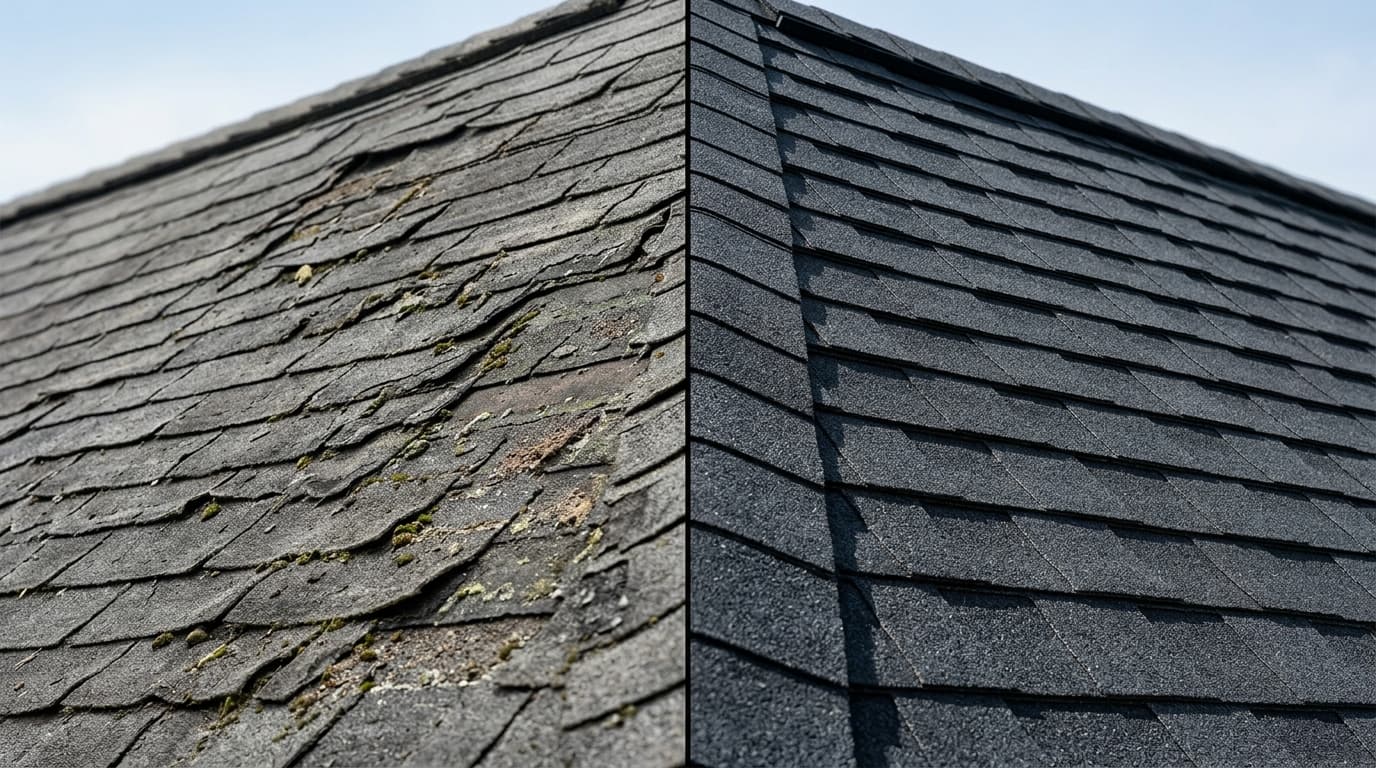
- The roof is near or past the end of its service life and showing widespread wear — broad granule loss, curling, cracking, or bald areas.
- Recurring leaks in different spots, which suggest the covering as a whole is failing rather than one isolated point.
- Damaged decking or underlayment, sagging, or evidence of long-term water intrusion that a surface patch will not solve.
- There are multiple existing layers, which can limit further overlays and often mean the next step is a full tear-off anyway.
- You keep paying for repeated repairs that only postpone an inevitable replacement.
Here replacement often wins on annualized cost because it buys many more years of protection and resets the whole system, even at a higher upfront price.
How to Compare Costs Fairly
The fairest way to compare the two paths is annualized cost: the total cost of a path divided by the number of usable years it buys.
Annualized cost = total path cost / usable years.
- Repair path: the repair quote (plus any repairs you realistically expect soon) divided by the remaining years you expect from the existing roof.
- Replacement path: the installed price of the new roof divided by the years you expect from it.
Whichever path has the lower cost per year is generally the better value. Conceptually, there is a break-even point — if the repair buys enough added years that its cost-per-year drops below the replacement's cost-per-year, repair wins; if not, replacement wins. The honesty of the "usable years" estimate matters more than any single price, and a mid-life roof with a localized problem will usually show more remaining years than an aged roof with recurring leaks.
You will sometimes hear a rough heuristic such as "replace if the roof is near the end of its life or the repair costs more than about half of a new roof." Treat that only as a rough starting point, not a rule — it ignores decking condition, recurring leaks, and existing layers. The annualized comparison is the honest version; use the calculator to run it with your numbers.
| Leans toward repair | Leans toward replace |
|---|---|
| Localized leak or damaged section | Widespread wear across the roof |
| Failed flashing on a sound field | Recurring leaks in different spots |
| Roof is mid-life, decking dry | Roof near end of life; decking damaged |
| Only one existing layer | Multiple existing layers in place |
| Repair is modest vs. replacement | Repair approaches or exceeds replacement cost |
Factors Beyond Cost
Money is only part of the decision. Weigh these alongside the annualized comparison:
- Water intrusion: an unresolved leak can damage decking, insulation, framing, and interiors — the cost of inaction can dwarf the roofing decision.
- Existing layers: local code often limits the number of roofing layers, which can force a tear-off rather than another overlay.
- Matching and appearance: a spot repair may not match aged shingles; whether that matters is up to you.
- Warranty and insurance: a full replacement typically carries fresh material and workmanship warranties; storm damage may involve an insurance claim with its own requirements.
Safety & Code Notes
Roof work happens at height, over an occupied home, and the roof is the primary barrier against water — so safety and a proper diagnosis matter:
- Working on a roof carries serious fall risk. Inspection and repair are jobs for a qualified professional with proper equipment, not a casual DIY task.
- Have a professional check underneath the surface — decking, underlayment, and flashing — because the real problem is often not visible from a photo of the shingles.
- Local code typically limits the number of roofing layers and may dictate underlayment, ice-and-water shield, and ventilation requirements on a replacement.
- Permits are commonly required for roof replacement and some repairs. Check your local building department.
If you have an active leak, sagging, or visible water damage inside the home, bring in a qualified roofer to assess the whole system before deciding anything.
Estimate your project
Adjust the inputs to match your project and local prices.
How many more years of use the repair realistically buys. Your estimate.
Expected usable years of the new unit. Your estimate.
e.g. extra energy cost of keeping an inefficient old unit.
The period you want to think over. If it exceeds the added repair years, you will be warned.
Frequently asked questions
- How do I decide whether to repair or replace my roof?
- There is no single rule. Weigh the roof's age and condition, whether the problem is localized or widespread, how many layers exist, and how your repair and replacement quotes compare. Have a professional assess what is actually failing, then compare the annualized cost of each path — total cost divided by usable years — using your own quotes in the calculator.
- Can one roof leak be repaired, or does it mean I need a new roof?
- A single, localized leak on an otherwise sound, mid-life roof can often be repaired — frequently it traces to failed flashing rather than the whole covering. Recurring leaks in different spots, widespread wear, or damaged decking are different and point toward replacement. A professional should confirm the cause before you decide.
- Does the number of existing roof layers affect the decision?
- Yes. Local code often limits how many roofing layers are allowed, so if you already have multiple layers, another overlay may not be permitted and a full tear-off and replacement may be the only compliant path. Factor the existing layers in when comparing repair against replacement.
Sources & pricing methodology
- Renovation Cost Lab user-input cost modelThis topic does not bundle fixed prices. The decision tool uses the repair quote, replacement quote, and expected usable years that YOU enter to compute and compare annualized cost. There are no national averages implied.
- General roofing safety and code referenceGeneral educational reference only. Layer limits, underlayment, ventilation, and permit requirements vary by jurisdiction — have the roof assessed by a qualified professional and follow your local code. Roof work carries fall risk and is not a casual DIY task.
See our full pricing methodology and editorial policy.